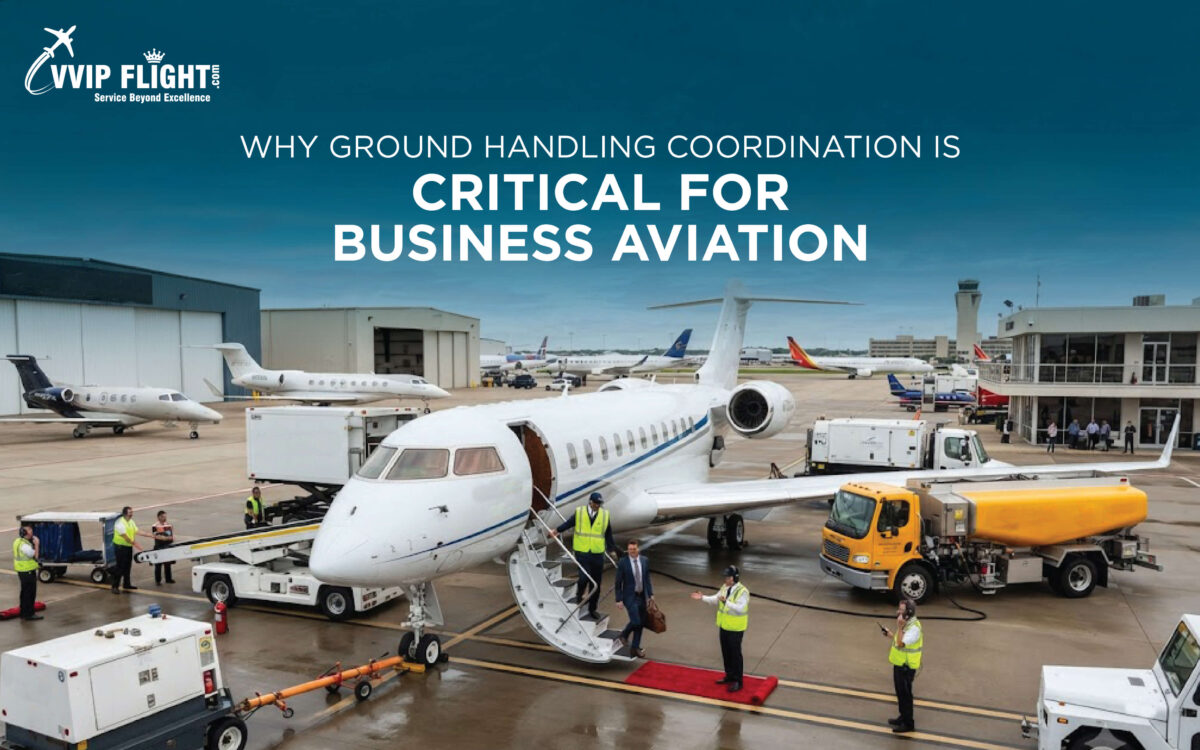
Ground handling is a service in which every other component of business aviation flights succeeds or fails. Everything could be prepared: the aircraft can be airworthy, the crew can be rested, the flight plan can be filed, the permit could be issued, and the passengers may be timely. Yet, if the ground handling at the destination airport is poorly coordinated, the departure will be delayed. The ramp workers will have no safety management system, and the aircraft will be exposed to danger from the moment of arrival. The handler did not confirm the availability of fuel, parking stand, and customs clearance, and then the crew finds out about the issues on the ground with no way to deal with them.
Understanding ground handling as an important operational function is the first step towards realization of its importance.
What Ground Handling Actually Covers
In business aviation, ground handling includes all services needed by the aircraft after landing until its next takeoff. Aircraft marshalling and parking, connection of ground power units to keep up systems while engines are off, fueling, baggage handling, cleaning of cabin, toilet and water services, catering services, pushback or tow-in of aircraft.
In addition to aircraft-related services, ground handling, when considered in international business aviation, involves coordination of customs and immigration procedures for passengers and crew, coordination with airport authority for slots and parking management, coordination of permits with civil aviation authority, and in some markets coordination with national security agency for security-related activities.
All these services have their own specialized equipment and procedures as well as skilled personnel. The handler needs to coordinate all services, which can be done at the same time, and ensure that one service does not endanger another service.
The IS-BAH Standard and Its Significance
The International Standard for Business Aircraft Handling, commonly called IS-BAH, came into existence in 2014 and is introduced by the International Business Aviation Council (IBAC). IS-BAH is the worldwide industry standard for handling services of business aviation. This standard is modeled after the existing IS-BAO standard for aircraft operators and incorporates a Safety Management System (SMS) concept in ground handling, which is in line with the ICAO requirements for SMS.
By 2024, there were 318 places registered at Stage 1 of the IS-BAH standard, with there being three stages. To acquire IS-BAH certification, the FBO will be audited in terms of its safety management systems, emergency response systems, organizational structure, administration, security procedures, training procedures, and operational procedures.
The Coordination Failure That Leads To Ground Handling Operations Problems
Problems related to ground handling operations in the business aviation field are not usually caused by a catastrophic event. In most instances, ground handling problems result from a failure in coordination: information that was present somewhere in the operations process but did not get to the people who required the information.
Fuel orders that were conveyed to the ground handler but not to the fueling truck drivers. Slot changes by ATC but not to the handling agency. A person suffering from a serious allergy but not covered in the catering briefing. An assigned parking stand which was confirmed in the morning but changed by the time of arrival of the aircraft.
The survey conducted by the NBAA Safety Committee revealed that ground handling is still considered one of the major concerns since the problem arises out of consistent and avoidable communication failures. Such failures do not usually arise from incompetence on the part of ground handlers. They usually arise out of ineffective communication between a series of services meant to be one.
The ground handler who operates as the true coordination center rather than as an individual service among many others resolves this problem in a systematic fashion. All aspects of the ground operation are handled through a single contact point, which has full oversight of all the simultaneous services being provided.
What Effective Ground Handling Looks Like In Action
In terms of normal operations for business aviation, good ground handling would have the marshaller in position before the arrival of the aircraft. Ground power will be plugged in minutes after the engines shut down. The fuel truck will be in position, not sent for after parking. Baggage will be unloaded and loaded according to the weight and balance requirement. Catering will be in position 60 to 90 minutes prior to take-off and will be verified against the crew briefing. The pushback vehicle will be ready for the departure once the departure checklist is initiated. The hard part about all of these aspects is coordinating all of them at once in an environment where time is of the essence and a delay in one aspect will mean delays in all of them.
As far as ground handling for business aviation operations in India and South Asia goes, the aspect entails coordination with the airport authority, DGCA, BCAS, customs, immigration, and slots coordinators. And the ground handler will act as the coordination point between all these entities, depending on the strength of his relationships with each of them.
Ground Handling in India: Special Considerations
There are some special considerations related to ground handling in India which become evident for operators who are not familiar with the country. The regulation of ground handling at airports managed by the Airports Authority of India takes place as per its policy. The entry of private ground handlers at major airports takes place within the parameters of the AAI Ground Handling Policy.
For the airports with FBO facilities such as VIDP, VABB, VAAH, VOCI, VOHS, VOGA, and VIJP and VOMM for domestic, the coordination between the FBO and the ramp authority is more organized compared to the airports running under the General Aviation Terminal. For the secondary airports that lack specific FBO facilities, the coordination is not centralized, and the handler’s relationship with the ramp control department of the airport authority becomes increasingly significant.
The regulations regarding the security requirements are set out in the form of a regulation made by the Bureau of Civil Aviation Security, BCAS. Personal frisking before entering the sterile pre-boarding area and hand baggage X-ray are mandatory for both crew members and ground personnel. Airside access passes of the handling staff are given by the airport authorities and cannot be exchanged between airports. In essence, if the handler handles the aircraft in Delhi, it will not be possible for him to send the non-accredited personnel to handle the aircraft in Mumbai. The handler needs an accredited team at every airport; otherwise, it will be a distant coordination service instead of ground handling.
The difference is crucial when choosing a ground handler for the Indian operation. The right approach would be asking specifically for which airports the handler has accredited airside personnel, and not which airports they say they operate at.
VVIP Flight Ground Handling Coordination
Having established itself as a provider of aviation services in India, Nepal, Bangladesh, Sri Lanka, Bhutan and the Maldives, VVIP Flight organizes the ground handling as a single process, and not as individually arranged activities. Our crew schedules the parking stand reservation, ground service equipment booking, aircraft fuelling, baggage handling, catering, immigration and customs services, as well as pushback according to the ground handling schedule of the plane.
In case you need help with the ground handling at any airport in the region, feel free to contact us at ops@vvipflight.com.
Disclaimer: Kindly note that the information provided in the above article is subject to change without prior notice. We recommend contacting our operations team for the latest regulations, updates, and accurate information before planning your trip.
Frequently Asked Questions (FAQs)
- What is IS-BAH and what is its significance in business aviation ground handling?
IS-BAH, or International Standard for Business Aircraft Handling, is the worldwide safety standard for ground handlers of business aviation services that was initiated by IBAC in 2014. It provides a Safety Management System approach to ground handling, in line with ICAO regulations. By 2024, 318 sites had attained IS-BAH Stage 1 registration.
- What exactly does business aviation ground handling entail?
Ground handling includes aircraft marshalling and parking, ground power unit servicing, fuelling, baggage handling, cabin cleaning, toilet and water servicing, catering provisioning, pushback, and, in international flights, customs and immigration coordination, permit coordination, and security coordination.
- How many ground accidents occur during the time the plane is handled by the ground handler?
As per IBAC figures, 57 percent of ground accidents happen when the aircraft is parked and under the supervision of the ground handler, and 71 percent are because of collisions with ground service equipment, other aircraft, or fixed objects.
- Why do ground handling problems occur in business aviation?
Ground handling failures arise not because of disasters but coordination failures, in other words, the information which was available within the organization and was required by the team, but the information never reached the team. Lack of communication between individual services is the leading reason for this problem.
- What qualities must an operator pay attention to when choosing a ground handler in India?
The operator should seek good relations with DGCA, BCAS, AAI, customs, immigration, and airport authorities, one point of contact for all the services, around-the-clock availability, and experience of operating this type of business.