
CategoriesBespoke Charter ServiceBusiness Aircraft Operations

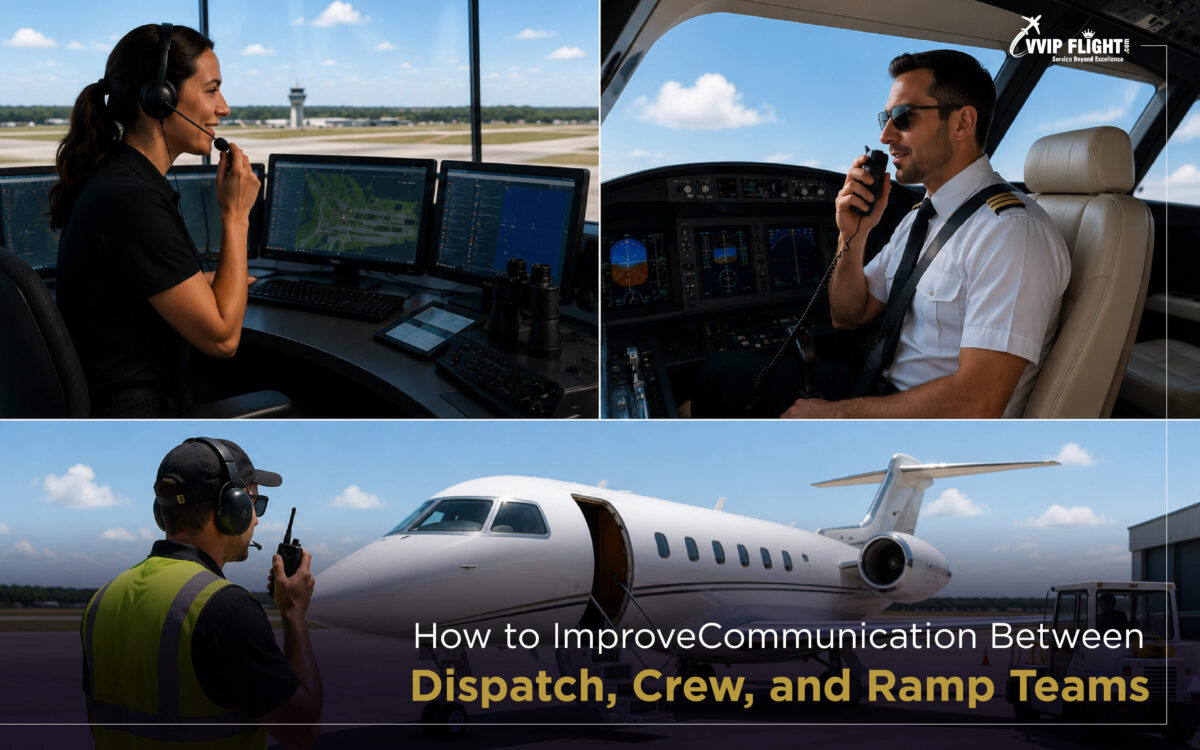
How to Improve Communication Between Dispatch, Crew, and Ramp Teams

Most operational disruptions in business aviation do not originate in the air. They develop on the ground, in the gap between what one team knows and what another team has not yet been told. A dispatcher who has updated the fuel order but has not relayed it to the ramp team, a crew that has confirmed a revised departure time but has not notified catering, or a ramp team that has been briefed on the wrong aircraft stand: each of these is a communication failure, and each one has the potential to delay departure or compromise safety.

Improving communication between dispatch, crew, and ramp teams is not a technology problem or a process problem in isolation. It is a coordination problem, and the solution lies in understanding where the gaps consistently occur and building the habits and structures that prevent them.

Why Communication Breaks Down in Ground Operations

Ground operations in business aviation involve multiple parties who are often working on different timelines, using different communication channels, and operating with different levels of situational awareness about the same aircraft movement.

The dispatcher typically has the most complete picture of the operation: the flight plan, the fuel order, the passenger manifest, the catering request, the departure slot, and any changes to any of these elements that have occurred since the original brief. The crew has detailed knowledge of the aircraft state and the operational requirements for the next sector. The ramp team knows the physical condition of the aircraft stand and the availability of ground service equipment.

The problem is that each party updates their own picture as information arrives, and those updates do not always reach the others in real time. A schedule change communicated from the principal’s office to the dispatcher at 10:00 may reach the crew at 10:30 and the ramp team at 11:00, by which point the fueling vehicle has already been dispatched based on the original departure time and the catering truck is circling the wrong terminal.

Establish a Single Communication Channel for Each Movement

The most effective structural improvement for ground operations communication is establishing a single, defined channel through which all updates for a specific aircraft movement are routed. This does not mean that all parties need to be on the same radio frequency or the same messaging platform. It means that there is a designated coordination point, typically the ground handler or the dispatcher, through whom all information passes before it reaches the teams that need to act on it.

When updates bypass this central coordination point and go directly from one party to another, the result is a fragmented picture in which different teams work from different versions of the same information. A crew that calls the fueling team directly to request additional fuel, without notifying the dispatcher, creates a discrepancy between the fuel order on record and the fuel actually uplifted, which affects weight and balance calculations downstream.

Pre-Departure Briefings: The Single Most Effective Tool

A structured pre-departure briefing that brings the relevant parties onto the same page before operations begin is the most consistently effective communication tool in business aviation ground operations. The briefing does not need to be long. It needs to cover the departure time, the parking stand, the fuel order, the passenger count and any special requirements, the catering delivery time, the pushback sequence, and any constraints specific to that airport or that aircraft on that day.

When this briefing happens in a structured, documented format rather than through informal conversation, the chances of a critical detail being missed or misunderstood are significantly reduced. The dispatcher typically owns this briefing and is responsible for ensuring that every party with a ground role has received the same information before they begin their task.

Managing Real-Time Changes Effectively

The briefing establishes the baseline. Changes to that baseline are where communication most frequently breaks down. A departure delay, a revised fuel requirement, an additional passenger, or a catering change all require the same communication discipline as the original brief: every party affected by the change needs to be notified promptly, through the established channel, with enough lead time to adjust their work.

The critical habit here is confirming receipt rather than assuming it. A dispatcher who sends a revised departure time by message and does not receive a confirmation from the ramp team cannot assume the message was received and acted on. In a busy ramp environment, messages are missed, and the consequence of an unconfirmed change is a ramp team working to the original schedule while the rest of the operation has moved to a new one.

Ramp-to-Flight-Deck Communication Protocols

Communication between the ramp team and the crew while the aircraft is on the stand is a specific area where clarity matters for safety reasons. Ramp-to-flight-deck communication, conducted through the aircraft’s interphone system or through hand signals and marshalling procedures, is used to relay information about pushback clearance, engine start authorization, and obstacle clearances around the aircraft.

In India, where ramp teams may be coordinating with ATC, the airport authority, and the crew simultaneously during a pushback, the communication sequence needs to be clearly established before the pushback begins. Who gives the all-clear for engine start, at which point in the pushback sequence, and how that signal is relayed to the crew are all decisions that should be made before the aircraft begins to move, not during it.

Using the Ground Handler as the Communication Hub

For operators without a dedicated dispatch function at each Indian airport, the ground handling agent serves as the practical communication hub between all ramp service providers, the airport authority, ATC, and the crew. This is the most efficient structure for business aviation operations in markets like India where the operator may be operating into a given airport infrequently and does not have established direct relationships with all of the local service providers.

The ground handler who functions effectively as a communication hub is not simply relaying information. They are actively managing the flow of information, prompting parties who have not confirmed receipt, flagging changes that will affect other parts of the operation, and maintaining a current operational picture that all parties can reference when questions arise.

How Technology Can Support Communication Without Replacing Coordination

Operations management tools, shared trip sheets, and digital briefing platforms can support communication between dispatch, crew, and ramp teams by giving all parties access to the same current information in a single place. These tools are useful when they are actually used by all parties, maintained in real time, and treated as the operational record rather than a secondary reference.

The risk with any technology-based communication tool is that it can create an illusion of coordination without delivering the substance of it. A trip sheet that was last updated six hours ago and has not been reviewed by the ramp team is not a communication tool. It is a document. Genuine coordination requires that updates are made promptly, that all parties are notified when changes occur, and that confirmation is sought rather than assumed.

For business aviation operations in India, where the ground handler is often coordinating with multiple service providers who may not share the same platform, the simplest and most reliable coordination tool remains direct, confirmed communication between the handler and each service provider, using whatever channel that provider reliably responds to.

How VVIP Flight Manages Ground Operations Communication

At VVIP Flight, our operations team acts as the central coordination point for all communication between ramp service providers, airport authorities, and crew for every aircraft movement we handle. Schedule changes, fuel revisions, passenger additions, and departure time updates are managed through our team and relayed to all affected parties simultaneously, rather than routed through separate channels that may not reach every party in time.

For assistance with ground handling coordination at any airport across India, Nepal, Bhutan, Bangladesh, Sri Lanka, or the Maldives, please contact our operations team at ops@vvipflight.com

Disclaimer: Kindly note that the information provided in the above article is subject to change without prior notice. We recommend contacting our operations team for the latest regulations, updates, and accurate information before planning your trip.

Frequently Asked Questions (FAQs)

1. Why does communication break down between dispatch, crew, and ramp teams? 
Each party works on different timelines and communication channels, updating their own picture as information arrives. Updates often do not reach all parties simultaneously, creating situations where different teams are working from different versions of the same information.

2. What is the most effective way to improve ground operations communication?
Establishing a single designated coordination point through which all operational updates pass before reaching the teams that need to act on them. This prevents fragmentation and ensures every party has the same current picture.

3. What should a pre-departure briefing cover? 
The briefing should cover departure time, parking stand, fuel order, passenger count and special requirements, catering delivery time, pushback sequence, and any airport-specific or aircraft-specific constraints for that day.

CategoriesBespoke Charter ServiceBusiness Aircraft Operations

Do’s and Don’ts of Business Aviation in India

India is one of the fastest-growing business aviation markets in the world, offering significant opportunities for operators, charter companies, and international flight departments. Successful operations in India, however, require careful planning, strong local knowledge, and a clear understanding of the regulatory environment.

The following guide covers the most important operational considerations for any business aviation movement into or out of India, organized as a practical reference for operators preparing their first Indian operation or refining their approach to a market they already know.

The Do’s

1. Plan Operations Well in Advance

India operates in a highly coordinated aviation environment. Landing permits, parking approvals, airport slots, ground support, and hotel availability all require early arrangement to avoid disruption. Last-minute coordination in India is rarely smooth, and during peak seasons, major events, or festival periods, it can become genuinely difficult regardless of how experienced the operator is.

A standard landing permit for a general aviation aircraft takes 3 working days for most operations, allowing the flight to operate on the fourth day after application submission. 

For flights originating from China, North Korea, Pakistan, Afghanistan, Iraq, Somalia, or Nigeria, this extends to 7 working days. 

Defense airport operations require significantly longer lead times of 3 to 4 weeks. 

These timelines are fixed, and no amount of urgency changes the regulatory process once an application is submitted.

2. Know the Popular Business Aviation Airports

India’s busiest general and business aviation airports include Delhi (VIDP), Mumbai (VABB), Kolkata (VECC), Bengaluru (VOBL), Hyderabad (VOHS), Jaipur (VIJP), Udaipur (VAUD), Goa (VIJO), Chennai (VOMM), Pune (VAPO), and Ahmedabad (VAAH). 

Each airport has its own operational characteristics, parking constraints, and ground handling infrastructure. Operators should familiarize themselves with the specific conditions at their destination rather than treating all Indian airports as operationally equivalent.

3. Understand FBO and General Aviation Terminal Availability

FBO facilities in India are currently available at Delhi (VIDP), Mumbai (VABB), Ahmedabad (VAAH), Kochi (VOCI), Hyderabad (VOHS), Goa (VOGA), and at Jaipur (VIJP) and Chennai (VOMM) for domestic operations only. 

For airports without dedicated FBO infrastructure, operations typically proceed through the General Aviation Terminal, with corresponding differences in passenger handling, lounge access, and ground coordination.

4. Secure Parking and Slots Before Finalizing the Schedule

Parking at most Indian airports is allocated on a first-come, first-served basis, and confirmations are generally issued closer to the flight date rather than far in advance. Mumbai (VABB) operates a strict 72-hour parking limitation for general aviation aircraft. 

Beyond three days, aircraft are required to reposition to an alternate airport such as Ahmedabad (VAAH). Other airports with known parking constraints include Chandigarh, Goa, Agra, and Pune.

Slots and parking availability can change rapidly. Always confirm parking arrangements in advance through your ground handling agent and maintain a contingency plan for repositioning if required.

5. Maintain Complete and Accurate Documentation

Aircraft documents, General Declaration, passenger manifests, crew licenses, Certificate of Airworthiness, Certificate of Registration, Insurance Certificate, and permit copies should all be accurate, current, and readily available throughout the operation. 

Documentation errors are one of the most common causes of delays at Indian airports, as incomplete or inconsistent paperwork typically results in clearances being held rather than processed, with questions asked later.

6. Complete the Mandatory E-Arrival Card Before Landing

India requires all international travelers to complete a mandatory digital e-Arrival Card before arriving in the country. The form can be submitted up to 72 hours before arrival through the official portal at indianvisaonline.gov.in

This applies to both passengers and crew. Failure to complete this before landing can create immigration delays that affect the broader schedule.

7. Complete the Customs Crew Baggage Declaration

All crew members entering India must complete a Customs Crew Baggage Declaration at the first port of entry using the Athithi 2.0 application, which is available on the Google Play Store. The declaration must be completed before clearing customs. This requirement is separate from the e-Arrival Card and applies specifically to crew at each point of entry.

8. Carry a Complete Tow Bar Assembly Onboard

Aircraft operating into India are required to carry a complete tow bar assembly onboard, including both the tow head and the tow bar itself. While tow bars may be available locally at some major airports, compatibility with specific aircraft types should always be confirmed before commencing operations. 

Operators who rely on local tow bar availability without advance confirmation have encountered delays when the available equipment was incompatible with their aircraft.

9. Understand ATC Departure Procedures

When departing India, a manually completed flight plan must be submitted directly to the Air Traffic Control at the departure airport. This is separate from any flight plan filed via AFTN. The manual flight plan may be prepared by the ground handling agent based on the flight plan provided by the crew, but it must be personally signed by the captain or by an authorized flight dispatcher. Once the flight plan is submitted, ATC provides two confirmation numbers: an Air Defence Clearance (ADC) number and a Flight Information Centre (FIC) number. The flight plan is cleared only after both confirmations are received, and the pilot in command may be asked to reconfirm both prior to obtaining departure clearance.

For arrivals, the ATC of the relevant Flight Information Region issues an ADC confirmation number once the aircraft enters Indian airspace. Approach plates for military and joint-use civilian and military airports are classified and are not published in the India AIP. Operators planning to operate into joint-use airfields should account for this in their flight planning.

10. Respect Crew Duty Limitations Within Indian Operations

Traffic conditions in Indian cities, airport distances from city centers, hotel availability, and operational delays can all directly affect crew duty time. Operators should build realistic ground time and rest assumptions into their schedule rather than using minimum duty calculations, since the buffer between planned and actual timelines is regularly tighter in India than in more predictable operating environments.

11. Work With an Experienced Local Ground Handler

Local operational knowledge is critical to smooth business aviation operations in India. An experienced ground handling partner coordinates permits, security requirements, parking, fuel, customs, immigration, ATC procedures, and real-time airport coordination, often simultaneously. Attempting to manage Indian operations remotely, without strong local support in place, consistently produces avoidable delays and communication gaps.

At VVIP Flight, we provide end-to-end ground handling and trip support for business and private aviation operations across India, Nepal, Bhutan, Bangladesh, Sri Lanka, and the Maldives. Our team manages the full operational process from permit application through to aircraft departure, coordinating with all relevant authorities to ensure each movement proceeds without disruption.

The Don’ts

1. Don’t Assume Airline Procedures Apply to Business Aviation

Business aviation operates entirely differently from scheduled airline services. Every flight movement in the general aviation space is individually customized and requires dedicated operational coordination. Processes, timelines, and infrastructure that apply to commercial airline operations are rarely transferable to general aviation movements without modification.

2. Don’t Depend on Last-Minute Planning

Last-minute changes in India carry a higher operational cost than in most markets. DGCA offices and relevant civil aviation authorities are closed on weekends and national holidays, which means permit revisions or corrections needed on a Saturday, Sunday, or public holiday cannot be processed until the following working day. During peak periods, including major sporting events, political movements, and religious festivals, airport capacity becomes constrained across parking, slots, hotel availability, and ground transportation simultaneously.

3. Don’t Ignore Permit and Slot Validity

Landing permits are valid for a window of plus or minus 48 hours from the Estimated Time of Departure stated in the application. Any change to the origin or destination airport requires the permit to be revised, not simply reused. Slots and parking approvals are similarly time-sensitive, and even small schedule changes may require re-coordination with the relevant airport authorities. This is not a formality that can be deferred to after departure.

4. Don’t Overlook Customs and Security Procedures

India maintains strict customs and aviation security standards across all airports. All passengers and crew are required to undergo personal frisking, and all hand baggage must pass through X-ray screening before entering the sterile pre-boarding area. E-cigarettes and satellite phones are prohibited in India, and neither passengers nor crew should carry these items into the country under any circumstances. VVIP movements and international arrivals at major airports may involve additional security coordination requirements, which should be confirmed with the ground handler well in advance.

5. Don’t Treat Ground Handling as a Basic Service

Ground handling for business aviation in India is a strategic operational function, not a commodity. It involves coordinating multiple agencies and service providers simultaneously, including airport authorities, DGCA, customs, immigration, security, fuel providers, and transportation. Selecting a ground handler purely on cost or assuming the service is interchangeable between providers frequently results in coordination failures that affect the entire operation.

6. Don’t Overlook the 14-Day Aircraft Limitation

Foreign-registered aircraft may remain in India for a maximum of 14 consecutive days. If the operation extends beyond this period without an official government invitation or confirmation from a local invitee, the aircraft must depart the country by the 14th day and return to restart the permitted period. Repositioning to Nepal or Sri Lanka is a common approach given the relatively short permit lead times in those countries, but a new Indian landing permit is required for the return flight.

7. Don’t Underestimate Peak Season Impact on Availability

Festivals, political events, major sporting tournaments, and winter operations can significantly affect airport capacity, parking availability, hotel access, and ground transportation across multiple cities simultaneously. Operators who schedule Indian movements during peak periods without accounting for reduced availability at each of these levels frequently find that their contingency options are also constrained.

8. Don’t Assume Visa-on-Arrival Is Reliably Available for Crew

On-arrival visas for crew are available at a limited number of airports, including Delhi, Mumbai, and Kolkata, subject to the conditions published by the Bureau of Immigration. These visas are valid for a maximum of 72 hours. Relying on an arrival visa rather than obtaining appropriate crew visas in advance introduces a variable into the entirely avoidable schedule. The consistent recommendation is that crew members obtain full visas before departure.

How VVIP Flight Supports Business Aviation Operations in India

Every point in this guide represents an area where the difference between a smooth operation and a disrupted one comes down to preparation, local knowledge, and having the right team coordinating on the ground. At VVIP Flight, we manage the complete operational process for business and private aviation movements across South Asia, from initial permit application through to departure, with a single point of contact managing every element of the ground operation.

For assistance with your next business aviation operation into India, please contact our team at ops@vvipflight.com

Disclaimer: Kindly note that the information provided in the above article is subject to change without prior notice. We recommend contacting our operations team for the latest regulations, updates, and accurate information before planning your trip.

Frequently Asked Questions (FAQs)

  1. How far in advance should a business aviation operator apply for a landing permit in India?

A standard landing permit requires 3 working days for most operations, meaning the flight can proceed on the fourth day after application. Flights from restricted countries require 7 working days, and defense airport operations require 3 to 4 weeks. Permit applications should always be submitted ahead of these minimum timelines to allow for any correction or re-coordination.

  1. What are the parking limitations for business aviation aircraft at Mumbai Airport?

Mumbai Airport (VABB) has a 72-hour parking limitation for general aviation aircraft. Operations requiring more than three days on the ground must reposition to an alternate airport, with Ahmedabad (VAAH) being the most commonly used option.

  1. Can business aviation crew obtain visas on arrival in India?

On-arrival visas for crew are available at certain airports, including Delhi, Mumbai, and Kolkata, but are valid for a maximum of 72 hours. Obtaining full crew visas before departure is strongly recommended to avoid any schedule risk from visa complications on arrival.

  1. Is a tow bar required for business aviation aircraft operating in India?

Yes. Aircraft operating into India are required to carry a complete tow bar assembly onboard, including the tow head and tow bar. While tow bars may be available at some major airports, compatibility with specific aircraft types should be confirmed in advance rather than assumed.

CategoriesBespoke Charter ServiceBusiness Aircraft Operations

India Landing Permit Lead Time for General Aviation, Technical Stops, Overflight & Air Ambulance Operations

Operating a General Aviation flight into India requires prior regulatory clearances and landing permissions from the Indian aviation authorities. Whether the operation involves a business jet, charter aircraft, technical fuel stop, overflight, defense airport operation, or air ambulance mission, operators must ensure all permits are obtained within the required timelines.

Permit processing timelines in India vary depending on:

  • Type of operation
  • Country of origin
  • Airport category
  • Nature of aircraft movement
  • Defense clearance requirements

India Landing Permit Lead Time for General Aviation Flights

For non-scheduled foreign-registered aircraft operating into India, landing permission must be obtained before the flight operates.

Standard Lead Time: 3 Working Days

The flight should operate on the 4th day after permit application submission. This applies to most international General Aviation operations into India.

Lead Time for PRC and Restricted-Origin Flights:  7 Working Days 

The flight should operate on the 8th day after application submission for flights originating from:

  • China
  • North Korea
  • Pakistan
  • Afghanistan
  • Iraq
  • Somalia
  • Nigeria

Documents Required:

  • Flight Details
  • Crew Details
  • Passenger Details
  • Aircraft Documents (Certificate of Airworthiness, Certificate of Registration, Noise Certificate & AOC)

India Technical Landing Permit Lead Time (Fuel Stop)

Aircraft making a technical stop in India for refueling or operational purposes also require prior landing permission.

Standard Technical Landing Permit Lead Time: 1 Working Day

The flight should operate on the 2nd day after the permit application. This applies to most technical stop operations.

Technical Landing Permit Lead Time for Restricted-Origin Flights: 3 Working Days

The flight should operate on the 4th day after the permit application for flights originating from:

  • China
  • North Korea
  • Pakistan
  • Afghanistan
  • Iraq
  • Somalia
  • Nigeria

Documents Required:

The following are required for India technical landing permit applications:

  • Flight Details
  • Crew Details
  • Passenger Details
  • Aircraft Documents (C of A, C of R, Noise Certificate & AOC)

India Overflight Permit Lead Time

Foreign-registered aircraft transiting Indian airspace without landing require overflight permission.

Standard Overflight Permit Lead Time: 1 Working Day

The flight should operate on the 2nd day after application submission.

Overflight Permit Lead Time for Restricted-Origin Flights: 3 Working Days

The flight should operate on the 4th day after the permit application for flights originating from:

  • China
  • North Korea
  • Pakistan
  • Afghanistan
  • Iraq
  • Somalia
  • Nigeria

India Defense Airport Landing Permit

Operations into defense or military airports in India require additional clearances and significantly longer processing timelines, as these airports are subject to both civil aviation and defense authority approvals.

Lead Time: 3 to 4 Weeks (15–20 Business Days)

Operators are strongly advised to apply at least one month in advance when planning operations into any defense airfield.

AOR — Air Operations Routine Number

For any aircraft, civil or military, landing at a defense airfield, an Air Operations Routine (AOR) Number is required in addition to the standard landing permit clearance issued by the Civil Aviation Office (DGCA).

Applications for AOR must be submitted to Air Headquarters (for IAF aerodromes) or Naval Headquarters (for coastline aerodromes), as applicable, through DGCA. The application must include full details of all foreign pilots and foreign passengers, including Passport details.

If a civil aircraft is operating for military purposes and carrying a military call sign, both landing permit clearance and AOR clearance are required. In such cases, the application must be made to both the Ministry of Defence and DGCA through the Ministry of External Affairs (MEA).

The formal proposal to MoD must be submitted at least one month prior to the proposed date of operations and should include:

  • Name of the defense aerodrome(s)
  • Proposed date/month of operations
  • Type of aircraft
  • Proposed schedule (if available)
  • Details of foreign pilots/crew
  • Details of foreign passengers onboard

Note: AOR is generally valid within a ±2 hour window of the Estimated Time of Departure (ETD).

We coordinate the AOR application process on your behalf. To initiate, we require complete crew details including: Name, Father’s Name, Passport Number, Date of Issue, Date of Expiry, Date of Birth, Nationality, and any other information as required by the authorities.

India Landing Permit Lead Time for Air Ambulance & Medical Relief Flights

For medical, ambulance, or relief mission flights, the standard minimum notice period requirement may be waived. Such cases are processed on the same day within a few hours, subject to the availability of required documents and the relevant CAA official.

Additional Documents Required (beyond standard flight and aircraft documents):

  • Treating Doctor Details
  • Hospital Details
  • Patient Medical Report
  • Crew Details
  • Passenger/Medical Escort Details
  • Aircraft Documents including Certificate of Airworthiness, Certificate of Registration, Insurance, Noise Certificate, and AOC

If the operation involves a defense airport or military-controlled aerodrome, additional defense clearances and AOR approval will also be required which can be obtained short notice. (see Defense Airport section above).

India Landing Permit for Military Flights

Permit applications for all military flights must be channeled through the respective country’s embassy or consulate via diplomatic channels. Approval from the Ministry of External Affairs (MEA) is also mandatory.

Military flights operating into Indian Air Force, Naval, or other defense-controlled aerodromes require an AOR Number in addition to the standard YA clearance.

Documents Required:

  • Aircraft Type and Registration
  • Flight Schedule
  • Purpose of Flight
  • Crew Details
  • Foreign Passenger Details
  • Passport Information and Nationality Details
  • Details of Military cargo onboard (if any)

Typical processing timeline: 15–20 business days. Operators are advised to apply at least one month in advance wherever possible.

India Landing Permit for Head of State & Diplomatic Flights

Head of State, diplomatic, and special government mission flights operating into India require prior diplomatic clearance along with civil aviation and, where applicable, defense approvals. Such operations are coordinated through official diplomatic channels and generally involve approvals from the Ministry of External Affairs (MEA).

For operations into defense airports or military-controlled airfields, an AOR Number and CAA clearance are also required depending on type of mission. AOR validity is generally ±2 hours of ETD.

Documents Required:

  • Diplomatic Note
  • Flight Schedule
  • Aircraft Details
  • Crew and Passenger Details
  • Passport Information
  • Purpose of Mission
  • Security Coordination Information

Lead times for diplomatic and Head of State flights vary depending on the airport, routing, security requirements, and the extent of defense coordination involved. Early application is strongly recommended.

Need Assistance With Your Landing Permits? We’re Happy to Help!

If you are planning your trip to India, our team will be pleased to assist you with the landing permits. 

We can assist you throughout the complete permit process by coordinating with the concerned authorities, managing documentation, and helping obtain all approvals in a smooth and timely manner.

Please feel free to contact us for any assistance at: ops@vvipflight.com

Disclaimer: Kindly note that the information provided in the above article is subject to change without prior notice. We recommend contacting our operations team for the latest regulations, updates, and accurate information before planning your trip.

Frequently Asked Questions (FAQs)

  1. How quickly can a technical landing or fuel stop permit be obtained in India?

Technical landing permits for refueling or operational stops are generally processed within 1 working day for most operators. Flights originating from certain restricted countries may require additional processing time.

  1. Do defense airports in India require special permits?

Yes. Operations into Indian military and defense airports require additional approvals beyond the standard DGCA landing permit. Operators must also obtain an Air Operations Routine (AOR) Number and complete the necessary defense authority clearance process, which can take 15–20 business days or longer, depending on the mission profile.

  1.  Are air ambulance and medical evacuation flights eligible for expedited permit approvals in India?

Yes. Air ambulance, medical evacuation, and humanitarian relief flights are often processed on a priority basis. Subject to the availability of required medical documentation and regulatory approvals, permits may be issued within a few hours for genuine emergency operations.

CategoriesBespoke Charter ServiceBusiness Aircraft Operations

What are FIC and ADC Numbers in India?

If you are operating a flight into or through Indian airspace, you will come across two clearance numbers that are mandatory before any departure: the FIC and the ADC. Understanding what they are, who issues them, and how to obtain them will save you time and prevent costly delays on the ground.

FIC (Flight Information Centre)

A FIC number is a confirmation code issued by the relevant ATC authority, verifying that your flight plan has been correctly filed, authenticated, and accepted for departure.

Who Issues the FIC?

The relevant ATC unit issues the FIC in coordination with the ATS (Air Traffic Services) units of the Airports Authority of India. The process is handled electronically through ATC and flight planning systems once the required flight plan has been submitted and all operational permits are in place.

When is the FIC Issued?

The FIC number is typically issued as soon as the flight plan is submitted. It is important to file your flight plan well in advance to allow sufficient processing time.

How Long is the FIC Valid?

The FIC is valid from 15 minutes before the filed ETD until 45 minutes after it. If your departure is delayed beyond that 45-minute window, or if there are any changes to the route or aircraft details, a fresh FIC will need to be obtained.

How Crew/Operator Can Obtain FIC

The FIC is normally coordinated on behalf of the operator by:

  • An authorised ground handling agency
  • A flight support company
  • The dispatcher or Operations Control Centre (OCC)

For flights overflying India without landing, the FIC number is generally conveyed through AFTN (Aeronautical Fixed Telecommunication Network). Alternatively, the crew can request the FIC number directly from ATC before entering the Indian FIR (Flight Information Region).

ADC (Air Defence Clearance)

The ADC is a mandatory operational clearance issued for aircraft movements in India, specifically for operations within the Air Defence Identification Zone (ADIZ). It confirms that the flight has been reviewed and cleared from an air defence and national security perspective, and that Indian military air defence authorities have been notified and have approved the operation.

Without a valid ADC, ATC will not normally permit departure. This is non-negotiable.

When is ADC Required?

ADC is required for the following types of operations:

  • International flights into or out of India
  • Domestic non-scheduled and private flights
  • Charter operations
  • Ferry flights
  • Military-sensitive routing operations

Who Issues the ADC?

The ADC is issued by the relevant Indian Air Defence authorities, specifically the Military Liaison Unit (MLU), in coordination with the Indian Air Force and the Airports Authority of India.

Like the FIC, it is processed electronically through ATC and flight planning systems after the required flight plan has been filed and operational permits obtained.

When is the ADC Issued?

The ADC number is typically issued approximately 1 hour before the filed ETD. Ensuring your flight plan and permits are submitted well ahead of time is essential to avoid any last-minute clearance issues.

How Long Is the ADC Valid?

The ADC follows the same validity window as the FIC: it is valid from 15 minutes before the filed ETD until 45 minutes after. Any delay beyond 45 minutes, a route change, or a change in aircraft details will require a fresh ADC to be obtained.

How Crew/Operator Can Obtain ADC

ADC is normally coordinated through:

  • An authorised ground handling agency
  • A flight support company
  • The dispatcher or Operations Control Centre (OCC)

For international business aviation in India, the supervisory or handling agent will coordinate the ADC process on behalf of the operator as part of the standard pre-departure process. 

For overflights, the ADC number is generally conveyed through AFTN. Alternatively, the crew may also request the ADC number from ATC before entering the Indian FIR (Flight Information Region).

The Combined FIC and ADC Process

  • In practice, the FIC and ADC are closely linked. Once the flight plan is submitted to ATC, both confirmation numbers are generally issued together as part of the same clearance process. 
  • The flight plan is only considered fully cleared when both the ADC and FIC numbers have been received and confirmed.
  • Prior to obtaining the final departure clearance, the Pilot-in-Command (PIC) may be required to reconfirm both the ADC and FIC numbers with ATC.

If you have any questions regarding the above article or require any assistance for your next trip to India, please feel free to contact our team at ops@vvipflight.com

Disclaimer: Kindly note that the information provided in the above article is subject to change without prior notice. We recommend contacting our operations team for the latest regulations, updates, and accurate information before planning your trip. 

Frequently Asked Questions (FAQs)

  1. What is the difference between an FIC Number and an ADC Number in India?

An FIC (Flight Information Centre) Number confirms that a flight plan has been filed, validated, and accepted by Air Traffic Control. An ADC (Air Defence Clearance) Number confirms that the flight has been cleared from an air defence and national security perspective. Both numbers are mandatory for most international and non-scheduled flight operations in India and must be obtained before departure.

  1. When are FIC and ADC Numbers issued in India?

The FIC Number is generally issued shortly after the flight plan is filed and accepted by ATC. The ADC Number is typically issued closer to departure, usually around one hour before the Estimated Time of Departure (ETD), after the necessary operational and security checks have been completed.

  1. How long are FIC and ADC Numbers valid?

Both FIC and ADC Numbers are generally valid from 15 minutes before the filed ETD until 45 minutes after the ETD. If the flight is delayed beyond this validity window or if there are changes to the route, aircraft, or flight details, fresh clearances may be required.

  1. Are FIC and ADC Numbers required for private jet and charter flights in India?

Yes. FIC and ADC clearances are typically required for all flights, including international business aviation operations, private jets, charter flights, ferry flights, and many domestic non-scheduled flights operating within Indian airspace. Operators should ensure both numbers are obtained before departure to avoid operational delays.

CategoriesAirportsBespoke Charter Service

FBO Services at Cochin Airport (COK, VOCI) for Private & Business Aviation

Cochin International Airport (IATA: COK | ICAO: VOCI), also known as Kochi International Airport, is the busiest and largest airport in Kerala and the eighth-busiest airport in India overall, located at Nedumbassery approximately 25 kilometres northeast of Kochi city centre. VOCI is the primary aviation gateway for southern Kerala and an important hub for private jets, business aircraft, charter operations, and diplomatic missions entering or departing the state.

VVIP Flight provides comprehensive ground handling and FBO facilitation services at Cochin International Airport (COK, VOCI). VVIP Flight works in close coordination with the airport operator and ground handling teams to facilitate seamless private and business aviation operations at the FBO at VOCI, managing everything from landing permits and ramp coordination to fuel, catering, and passenger handling on behalf of operators and passengers.

The FBO and General Aviation Terminal at Cochin Airport (COK, VOCI)

Cochin International Airport has an FBO facility and a General Aviation Terminal (GAT) or Corporate Aviation Terminal (CAT) available for private and business aviation operators, with VIP lounges available for arriving and departing VVIP passengers and crew. 

VVIP Flight facilitates access to and operations through the FBO and GA Terminal at COK, coordinating all ground handling, permits, fuel, passenger services, and logistics on behalf of visiting operators and passengers.

Ground Handling and Trip Support Services at Cochin Airport (COK, VOCI)

  • Passenger Handling and Meet and Greet: VVIP Flight coordinates complete arrival and departure experiences for private, corporate, and VVIP passengers at Cochin Airport: personalised meet and greet, access to VIP lounge facilities, expedited customs and immigration coordination, and secure ground transportation. Every passenger movement is managed with the discretion and efficiency that private aviation demands.
  • Ramp Handling and Aircraft Supervision: VVIP Flight coordinates ramp handling at VOCI, managing aircraft marshalling, parking coordination, pushback, towing, GPU, air-starter units, air-conditioning units, cabin cleaning, baggage handling, and full tarmac supervision to strict safety standards. Parking at Cochin International Airport requires prior approval. VVIP Flight coordinates all applications and ramp logistics on behalf of operators.
  • Permit Handling for Foreign Aircraft: India’s permit requirements for foreign-registered business aircraft are among the most regulatory-intensive in Asia. VVIP Flight manages the complete permit process for all operations into VOCI/COK — Air Defence Clearance (ADC), Flight Information Centre (FIC) clearance, India landing and overflight permits through the Ministry of Civil Aviation and DGCA, diplomatic and military clearances for Head of State, government, and embassy aircraft, and full slot and PPR coordination with Cochin Airport authorities.
  • Aviation Fuel Services at Cochin Airport: VVIP Flight provides Jet A1 aviation fuel services at Cochin International Airport (VOCI, COK) through authorised fuel providers, ensuring precise and reliable fuelling arrangements to maintain flight punctuality and operational efficiency. AVGAS coordination (Subject to availability) is also available at VOCI. Whether the requirement is a rapid turnaround refuel or an extended overnight arrangement, VVIP Flight ensures prompt fuel availability for every operation.
  • Airport Catering and Cargo Services: Premium 5-star in-flight and ground catering is coordinated by VVIP Flight at COK/VOCI. For cargo, VVIP Flight provides comprehensive coordination covering general cargo, warehouse management, cargo build-up and breakdown, perishable cargo, odd-size cargo, heavy machinery, live animals, human remains, tissue and organ cargo, mail cargo, and dangerous goods (DGR).
  • Aircraft Security Services: VVIP Flight coordinates aircraft security at Cochin International Airport, ensuring safety, supervision, and peace of mind for operators and passengers throughout the aircraft’s time on the ground at VOCI/COK.
  • Crew Support and Ground Transportation: VVIP Flight assists with crew movement and logistics at Cochin Airport, including hotel arrangements, crew transfers, secured ground transportation, and local coordination support for all private aviation and charter operations through VOCI/COK.

Why Choose VVIP Flight for Ground Handling at Cochin Airport?

Cochin is Kerala’s commercial capital and a key gateway for international private aviation connecting southern India to the Gulf, Southeast Asia, and Europe. VVIP Flight offers:

  • 24/7 operational availability: Around the clock for all arrivals, departures, and operational requirements.
  • Regulatory expertise: Complete knowledge of DGCA, BCAS, AAI, and Ministry of Civil Aviation requirements, eliminating permit and compliance delays most frequently experienced by foreign operators.
  • Single-point coordination: Permits, fuel, passenger handling, catering, cargo, security, and ground transport through one experienced team working in close coordination with the FBO operator and airport authorities.
  • Head of State and diplomatic capability: Proven track record across VOCI and India’s most operationally sensitive aviation missions.

Operating at Cochin Airport (COK, VOCI) — Key Information for Operators

  • Airport: Cochin International Airport (CIAL)
  • IATA / ICAO: COK / VOCI
  • Location: Nedumbassery, approximately 25 km northeast of Kochi, Kerala, India
  • Distance to city: Approximately 14 km 
  • Operating hours: 24 hours 
  • VIP lounge: Available with butler service 
  • Jet A1 fuel: Available, coordinated by VVIP Flight 
  • Catering: Available, coordinated by VVIP Flight 
  • ATC: Available in English 
  • Medical / paramedic: Dedicated team and cardiac ambulance at GA Terminal

Arrange Ground Handling at Cochin Airport (COK, VOCI) with VVIP Flight

Whether you are planning a private jet arrival, a corporate charter, a diplomatic mission, a medical evacuation, or a Head of State operation through Cochin International Airport (COK, VOCI), VVIP Flight provides the trip support expertise, permit coordination, fuel services, and operational depth that Kerala’s most demanding private aviation requirements call for.

Frequently Asked Questions (FAQs)

  1. Does Cochin Airport have an FBO and General Aviation Terminal for private jets?

Yes. Cochin International Airport (COK/VOCI) has an FBO facility and a General Aviation Terminal (GAT) / Corporate Aviation Terminal (CAT) available for private and business aviation operators, along with VIP lounge facilities for arriving and departing passengers. VVIP Flight facilitates access to and operations through the FBO and GA Terminal for all visiting private and business aviation operators at VOCI.

  1. What ground handling services does VVIP Flight provide at Cochin Airport?

VVIP Flight provides comprehensive trip support and ground handling coordination at Cochin International Airport (COK, VOCI), covering passenger handling, meet and greet, ramp coordination, permit handling, Jet A1 fuel, AVGAS, catering, cargo, aircraft security, and ground transportation. VVIP Flight works in coordination with the airport operator and handling teams to facilitate seamless private and business aviation operations at VOCI. All services are available 24/7.

Quick Enquiry

Quick Enquiry
Close