
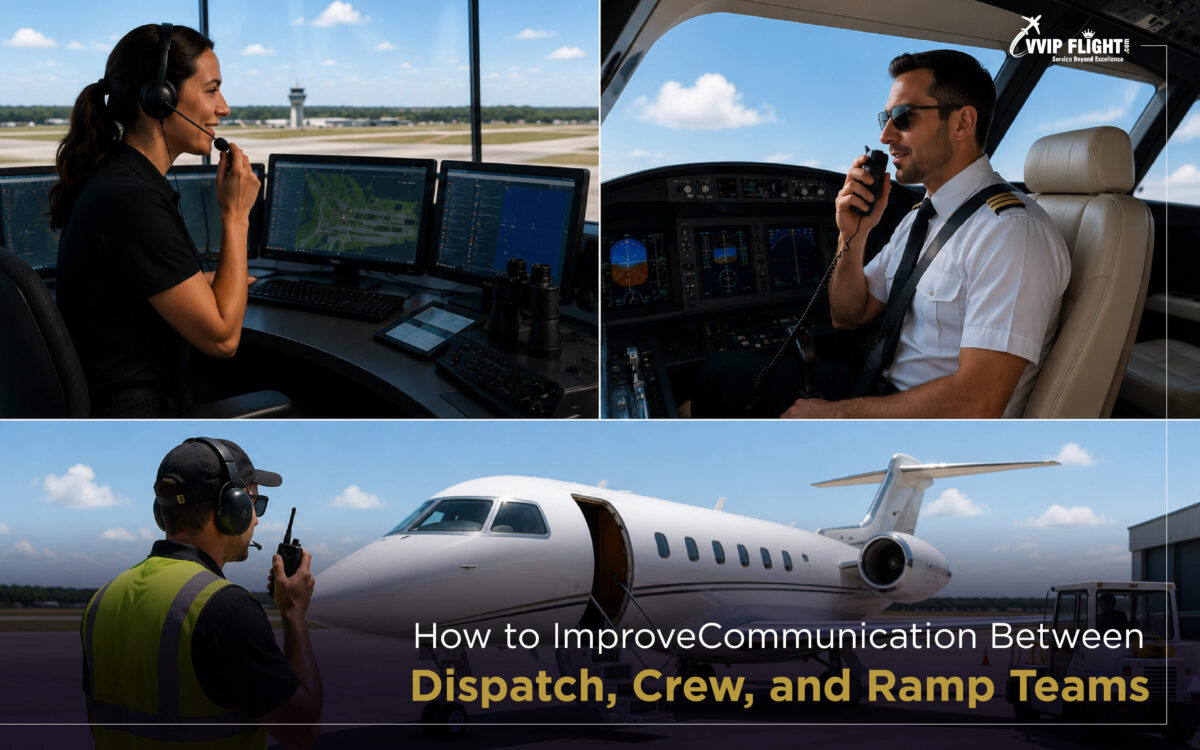
Most operational disruptions in business aviation do not originate in the air. They develop on the ground, in the gap between what one team knows and what another team has not yet been told. A dispatcher who has updated the fuel order but has not relayed it to the ramp team, a crew that has confirmed a revised departure time but has not notified catering, or a ramp team that has been briefed on the wrong aircraft stand: each of these is a communication failure, and each one has the potential to delay departure or compromise safety.
Improving communication between dispatch, crew, and ramp teams is not a technology problem or a process problem in isolation. It is a coordination problem, and the solution lies in understanding where the gaps consistently occur and building the habits and structures that prevent them.
Why Communication Breaks Down in Ground Operations
Ground operations in business aviation involve multiple parties who are often working on different timelines, using different communication channels, and operating with different levels of situational awareness about the same aircraft movement.
The dispatcher typically has the most complete picture of the operation: the flight plan, the fuel order, the passenger manifest, the catering request, the departure slot, and any changes to any of these elements that have occurred since the original brief. The crew has detailed knowledge of the aircraft state and the operational requirements for the next sector. The ramp team knows the physical condition of the aircraft stand and the availability of ground service equipment.
The problem is that each party updates their own picture as information arrives, and those updates do not always reach the others in real time. A schedule change communicated from the principal’s office to the dispatcher at 10:00 may reach the crew at 10:30 and the ramp team at 11:00, by which point the fueling vehicle has already been dispatched based on the original departure time and the catering truck is circling the wrong terminal.
Establish a Single Communication Channel for Each Movement
The most effective structural improvement for ground operations communication is establishing a single, defined channel through which all updates for a specific aircraft movement are routed. This does not mean that all parties need to be on the same radio frequency or the same messaging platform. It means that there is a designated coordination point, typically the ground handler or the dispatcher, through whom all information passes before it reaches the teams that need to act on it.
When updates bypass this central coordination point and go directly from one party to another, the result is a fragmented picture in which different teams work from different versions of the same information. A crew that calls the fueling team directly to request additional fuel, without notifying the dispatcher, creates a discrepancy between the fuel order on record and the fuel actually uplifted, which affects weight and balance calculations downstream.
Pre-Departure Briefings: The Single Most Effective Tool
A structured pre-departure briefing that brings the relevant parties onto the same page before operations begin is the most consistently effective communication tool in business aviation ground operations. The briefing does not need to be long. It needs to cover the departure time, the parking stand, the fuel order, the passenger count and any special requirements, the catering delivery time, the pushback sequence, and any constraints specific to that airport or that aircraft on that day.
When this briefing happens in a structured, documented format rather than through informal conversation, the chances of a critical detail being missed or misunderstood are significantly reduced. The dispatcher typically owns this briefing and is responsible for ensuring that every party with a ground role has received the same information before they begin their task.
Managing Real-Time Changes Effectively
The briefing establishes the baseline. Changes to that baseline are where communication most frequently breaks down. A departure delay, a revised fuel requirement, an additional passenger, or a catering change all require the same communication discipline as the original brief: every party affected by the change needs to be notified promptly, through the established channel, with enough lead time to adjust their work.
The critical habit here is confirming receipt rather than assuming it. A dispatcher who sends a revised departure time by message and does not receive a confirmation from the ramp team cannot assume the message was received and acted on. In a busy ramp environment, messages are missed, and the consequence of an unconfirmed change is a ramp team working to the original schedule while the rest of the operation has moved to a new one.
Ramp-to-Flight-Deck Communication Protocols
Communication between the ramp team and the crew while the aircraft is on the stand is a specific area where clarity matters for safety reasons. Ramp-to-flight-deck communication, conducted through the aircraft’s interphone system or through hand signals and marshalling procedures, is used to relay information about pushback clearance, engine start authorization, and obstacle clearances around the aircraft.
In India, where ramp teams may be coordinating with ATC, the airport authority, and the crew simultaneously during a pushback, the communication sequence needs to be clearly established before the pushback begins. Who gives the all-clear for engine start, at which point in the pushback sequence, and how that signal is relayed to the crew are all decisions that should be made before the aircraft begins to move, not during it.
Using the Ground Handler as the Communication Hub
For operators without a dedicated dispatch function at each Indian airport, the ground handling agent serves as the practical communication hub between all ramp service providers, the airport authority, ATC, and the crew. This is the most efficient structure for business aviation operations in markets like India where the operator may be operating into a given airport infrequently and does not have established direct relationships with all of the local service providers.
The ground handler who functions effectively as a communication hub is not simply relaying information. They are actively managing the flow of information, prompting parties who have not confirmed receipt, flagging changes that will affect other parts of the operation, and maintaining a current operational picture that all parties can reference when questions arise.
How Technology Can Support Communication Without Replacing Coordination
Operations management tools, shared trip sheets, and digital briefing platforms can support communication between dispatch, crew, and ramp teams by giving all parties access to the same current information in a single place. These tools are useful when they are actually used by all parties, maintained in real time, and treated as the operational record rather than a secondary reference.
The risk with any technology-based communication tool is that it can create an illusion of coordination without delivering the substance of it. A trip sheet that was last updated six hours ago and has not been reviewed by the ramp team is not a communication tool. It is a document. Genuine coordination requires that updates are made promptly, that all parties are notified when changes occur, and that confirmation is sought rather than assumed.
For business aviation operations in India, where the ground handler is often coordinating with multiple service providers who may not share the same platform, the simplest and most reliable coordination tool remains direct, confirmed communication between the handler and each service provider, using whatever channel that provider reliably responds to.
How VVIP Flight Manages Ground Operations Communication
At VVIP Flight, our operations team acts as the central coordination point for all communication between ramp service providers, airport authorities, and crew for every aircraft movement we handle. Schedule changes, fuel revisions, passenger additions, and departure time updates are managed through our team and relayed to all affected parties simultaneously, rather than routed through separate channels that may not reach every party in time.
For assistance with ground handling coordination at any airport across India, Nepal, Bhutan, Bangladesh, Sri Lanka, or the Maldives, please contact our operations team at ops@vvipflight.com.
Disclaimer: Kindly note that the information provided in the above article is subject to change without prior notice. We recommend contacting our operations team for the latest regulations, updates, and accurate information before planning your trip.
Frequently Asked Questions (FAQs)
1. Why does communication break down between dispatch, crew, and ramp teams?
Each party works on different timelines and communication channels, updating their own picture as information arrives. Updates often do not reach all parties simultaneously, creating situations where different teams are working from different versions of the same information.
2. What is the most effective way to improve ground operations communication?
Establishing a single designated coordination point through which all operational updates pass before reaching the teams that need to act on them. This prevents fragmentation and ensures every party has the same current picture.
3. What should a pre-departure briefing cover?
The briefing should cover departure time, parking stand, fuel order, passenger count and special requirements, catering delivery time, pushback sequence, and any airport-specific or aircraft-specific constraints for that day.