
CategoriesBusiness Aircraft Operations

Why Airport Slots Matter in Private Aviation

Most private aviation passengers understand, at least broadly, that flights require permits and that fuel needs to be arranged in advance. Fewer are aware that the departure or arrival time they have been given is contingent on something the crew and handling agent have been working to secure in the background: an airport slot.

A slot is the authorization to use a specific runway and airport infrastructure at a specific time. Without it, the flight cannot legally land or depart, regardless of whether the permit is in order, the fuel is loaded, and the passengers are on board. In busy aviation markets like India, slot coordination is one of the most practically consequential elements of trip planning, and it is one of the most consistently underestimated.

Understanding Airport Slots

In the context of aviation, a slot is a time window allocated by the airport authority or the designated slot coordinator within which an aircraft is authorized to arrive or depart. It is not simply a scheduled time on a plan. It is a formal allocation of airport resources, including runway capacity, taxiway access, and in some cases terminal or apron infrastructure, that is issued based on the airport’s capacity model for that day.

At airports that operate under formal slot coordination, any aircraft that wishes to land or depart must hold a valid slot for that movement. Operating outside a confirmed slot, even by a few minutes in some cases, can result in the flight being held at the departure airport, being directed to hold in the air near the destination, or being assigned a delayed departure clearance that cascades into the rest of the day’s schedule.

How Slots Work Differently in Private Aviation

In commercial aviation, slots are allocated through a structured seasonal coordination process managed under international guidelines, and airlines hold slots on a long-term basis that they reuse across multiple seasons. In private aviation, the process is different. Non-scheduled flights do not hold seasonal slot allocations. Each flight requires its own slot request, submitted in advance for the specific time and date of the movement.

This means that a private jet operator cannot assume slot availability simply because a commercial flight operates on the same route at the same time. Commercial slots and general aviation slots are managed separately, and the availability of general aviation slots at a given airport and time depends on the residual capacity after commercial operations are accounted for.

What PPR Means and Why It Matters

PPR stands for Prior Permission Required. It is an airport-specific designation that means no aircraft may arrive at or depart from that airport without obtaining advance permission from the airport authority, in addition to any standard slot or permit requirements.

PPR is a common requirement at Indian airports for general aviation aircraft, and it applies at many airports where the commercial slot framework does not itself capture all general aviation movements. An operator who arrives at a PPR airport without having obtained prior permission faces the possibility of being refused service, directed to an alternate airport, or incurring delays while permission is sought on the ground.

The practical implication is that PPR must be factored into the pre-departure timeline in the same way as the landing permit. It is not a formality that can be obtained quickly on the day of the flight. It requires advance coordination with the airport authority, and at some airports the lead time for PPR approval runs in parallel with the permit processing timeline rather than sitting entirely within it.

Slot Constraints at Indian Airports

India’s busiest commercial airports impose the most significant slot constraints on general aviation operations. Delhi and Mumbai are the clearest examples. At both airports, general aviation slots during peak commercial traffic hours can be extremely limited, and obtaining a slot at a preferred time is not guaranteed even with advance notice.

At Mumbai specifically, the combination of limited general aviation apron space and high commercial traffic density means that slot availability for business aviation is constrained not only by runway capacity but also by the physical availability of a stand when the aircraft lands. A slot that places the aircraft on approach during a period when all general aviation stands are occupied by other aircraft is operationally unusable even if it has been formally allocated.

Hyderabad, Bengaluru, Jaipur, and Ahmedabad have grown their business aviation handling capacity and generally offer more slot flexibility for general aviation than Delhi or Mumbai, though advance coordination is still required at all of them.

How Slot Changes Affect the Entire Operation

A slot change does not only affect the departure or arrival time. It cascades through the entire ground operation. A departure slot that moves by two hours means the fueling sequence, the catering delivery, the passenger transportation from the hotel, the crew’s duty time calculation, and the permit validity window all need to be reviewed and, in some cases, revised.

This is why slot coordination needs to happen early in the planning process and why changes to slots need to be communicated to all relevant parties simultaneously rather than sequentially. A dispatch team that updates the slot but does not immediately notify the catering supplier and the transport provider creates a coordination gap that will be discovered only when one of those parties arrives at the original time and finds the departure has moved.

Planning Slots for Multi-Leg Indian Operations

For operators planning multi-stop itineraries across India, slot coordination across all legs needs to happen as part of a single planning process rather than leg by leg. A slot change on the first departure affects the arrival time for the second leg, which affects the slot request for the third leg, and so on through the sequence. Managing these dependencies individually rather than as an interconnected plan creates a fragile schedule where a single change at one end propagates through every subsequent leg.

The ground handler coordinating a multi-leg Indian operation is the natural owner of this slot sequencing, since they have the visibility across all legs and the relationships with the airport authorities at each stop.

Slot Coordination Across Neighboring Countries

For operators whose routes extend beyond India into Nepal, Bangladesh, Sri Lanka, Bhutan, or the Maldives, slot coordination requirements exist at every airport in the sequence, not only the Indian ones. Each country’s civil aviation authority manages its own slot framework, and the general aviation slot process differs between countries in terms of lead time, the authority responsible for allocation, and the documentation required alongside the slot request.

Nepal and Bangladesh, for example, both require slot coordination for general aviation aircraft at their major airports, and the timelines for approval are not always as short as operators who are unfamiliar with these markets assume. An operator who has confirmed slots for all Indian legs of a multi-country South Asian itinerary but has not addressed Nepal or Bangladesh slots may find that the international legs of the route are the weakest link in an otherwise well-planned operation.

VVIP Flight manages slot coordination across all six countries in its coverage network, which means operators planning multi-country South Asian routes can address the full sequence through a single coordination process rather than managing each country separately.

How VVIP Flight Manages Slot Coordination

At VVIP Flight, slot and PPR coordination is managed for every aircraft movement we handle as part of the pre-departure process. We submit slot requests and PPR applications to the relevant airport authorities in advance, monitor confirmation status, and manage revisions when schedule changes occur. For multi-leg operations, we coordinate slots across all destinations as a sequenced plan rather than managing each leg independently, ensuring that a change on one leg is reflected across the full itinerary before the aircraft departs.

For assistance with slot coordination and ground handling at any airport across India, Nepal, Bhutan, Bangladesh, Sri Lanka, or the Maldives, please contact our operations team at ops@vvipflight.com. 

Disclaimer: Kindly note that the information provided in the above article is subject to change without prior notice. We recommend contacting our operations team for the latest regulations, updates, and accurate information before planning your trip.

Frequently Asked Questions (FAQs)

  1. What is an airport slot in the context of private aviation? 

A slot is a formal authorization to use a specific runway and airport infrastructure at a specific time. In private aviation, slots are requested individually for each flight rather than held on a long-term seasonal basis as in commercial aviation.

  1. What does PPR mean at an Indian airport? 

PPR stands for Prior Permission Required. It means the aircraft must obtain advance permission from the airport authority before arriving or departing, in addition to any standard slot or permit requirements.

  1. How do commercial and private aviation slots differ? 

Commercial airlines hold long-term seasonal slot allocations. Private aviation operators must request a new slot for each flight, and the availability of general aviation slots depends on residual capacity after commercial operations are accounted for.

  1. How does a slot change affect the rest of a business aviation operation? 

A slot change cascades through the entire operation, affecting fueling sequences, catering delivery, passenger transportation, crew duty time, and permit validity. All affected parties need to be notified simultaneously when a slot changes.


CategoriesBusiness Aircraft Operations

What to Do When Ramp Parking is Unavailable at Your Destination

Parking unavailability is one of the most disruptive operational problems a business aviation operator can encounter in India, because it is often discovered late and its consequences ripple through every other element of the operation. A flight that arrives at its destination without a confirmed parking stand faces a set of decisions that need to be made quickly, with limited information, and with a schedule that may already be under pressure.

This article explains why parking unavailability happens at Indian airports, what the options are when it occurs, and how the problem can be avoided through better pre-departure planning.

Why Ramp Parking Becomes Unavailable

At most Indian airports, general aviation parking is allocated on a first-come, first-served basis. There is no advance reservation system in the way that hotel rooms or restaurant tables can be reserved weeks ahead with a guaranteed hold. Confirmations are typically issued closer to the date of the operation, and the availability picture at any given airport can change rapidly due to schedule compression, unplanned aircraft stays, maintenance holds, or the arrival of higher-priority movements such as government or military aircraft.

Mumbai presents the most structured parking constraint in the Indian business aviation network. The 72-hour parking limitation for general aviation aircraft at VABB Airport means that any aircraft that has occupied a stand for three days must depart or reposition, and new arrivals may find the available stands reduced by aircraft that arrived just ahead of them. During peak periods, including major corporate events, political movements, and festival seasons, this constraint tightens considerably.

Other airports with documented parking constraints include Pune, Goa, Chandigarh, and Agra, where stand availability is limited by the physical size of the general aviation apron relative to the demand on it during peak periods.

Step 1: Confirm Parking Before the Aircraft Departs

The most effective solution to parking unavailability is confirming a stand before the aircraft leaves its origin, not after it has landed. This confirmation should be obtained from the handling agent at the destination, who coordinates directly with the airport authority’s ramp control to verify that a stand will be available at the planned arrival time.

This confirmation is not the same as an assumption of availability based on experience at that airport. A stand that was available on a previous visit does not remain available by default. Each operation requires its own confirmation, particularly at high-traffic airports or during periods when other large movements are planned.

The confirmation should also specify the parking stand location and the planned duration of the stay, since some stands have limitations on aircraft size, overnight stays, or extended ground time that are not always visible in general availability information.

Step 2: Know the 72-Hour Rule and Plan Around It

For operations into Mumbai, the 72-hour limitation is not a guideline. It is an enforced constraint, and an aircraft that does not depart within that window will be required to reposition by the airport authority. Operators planning trips that require more than three days of ground time in Mumbai must plan a repositioning movement, typically to Ahmedabad, as part of the original schedule rather than as a contingency.

Understanding this constraint at the planning stage, rather than discovering it on Day 3 of a ground stop, is the difference between a managed repositioning and an unplanned disruption.

Step 3: Identify Alternate Airports in Advance

For operations where parking availability at the destination cannot be confirmed, or where a longer stay than the airport can accommodate is required, identifying an alternate airport in advance is the correct operational response. This means selecting an airport close enough to the destination to serve the operational purpose while offering more reliable parking availability.

For Mumbai operations requiring extended stays, Ahmedabad is the established alternate. For operations into constrained airports across India more broadly, the nearest major gateway with consistent general aviation parking capacity is the standard fallback. The handling agent at the destination is the best source of current information on alternate options, since they have direct knowledge of the local airport network.

Step 4: Confirm the Impact on Permits and Slots

A parking unavailability that forces a change of destination airport does not only affect the ground plan. It affects the landing permit, which is issued for a specific destination and cannot simply be transferred to an alternate. A change of destination requires the permit to be revised, and that revision follows the same processing timeline as the original application.

Slots and PPR at the revised destination also need to be arranged separately from any slots that may have been confirmed at the original airport. These coordination requirements need to happen simultaneously with the operational decision to change airports, not after it, since the permit validity window of plus or minus 48 hours from ETD is running from the moment the flight plan is filed.

Step 5: For Extended Stays, Consider the 14-Day Limitation

Beyond the airport-level parking constraints, operators planning extended stays in India must account for the regulatory limit on how long a foreign-registered aircraft may remain in the country. Foreign aircraft are permitted to stay in India for a maximum of 14 consecutive days. Operators whose mission requires a longer ground presence must plan a departure, typically to a neighboring country, and return on a new landing permit.

This planning should happen before the aircraft departs for India, since discovering the 14-day limitation midway through an operation that requires 18 days of ground time leaves limited options for managing the departure and return without disrupting the overall schedule.

How Advance Intelligence Prevents Parking Problems

The most underused tool for managing parking availability is simply asking the right question early enough. Operators who contact their handling agent at the destination as part of the initial trip planning process, rather than as a final confirmation step, receive the availability picture at a point when there is still time to adjust the plan.

An agent who is asked about parking availability two weeks before a planned operation can advise on whether the destination airport is likely to be constrained on those dates, whether a parallel event or political movement is known to be placing additional pressure on the ramp, and whether the planned stay duration is within what the airport can accommodate. All of this information is available before the operation is finalized, and it costs nothing to obtain other than the time required to ask.

Operators who treat the handling agent briefing as a day-before formality rather than a planning resource consistently encounter avoidable problems that earlier communication would have resolved.

How VVIP Flight Manages Parking Coordination

At VVIP Flight, parking confirmation is part of the pre-departure coordination process for every operation we handle. We liaise directly with the airport authority at the destination to confirm stand availability, stand location, and any constraints specific to the planned stay duration before the aircraft departs. For operations into Mumbai, we coordinate the 72-hour constraint into the ground schedule from the outset and arrange repositioning to Ahmedabad where required. For operations involving multiple Indian destinations, we manage parking confirmation at each stop as part of a single coordinated trip plan.

For assistance with parking coordination and ramp handling across India, Nepal, Bhutan, Bangladesh, Sri Lanka, or the Maldives, please contact our operations team at ops@vvipflight.com. 

Disclaimer: Kindly note that the information provided in the above article is subject to change without prior notice. We recommend contacting our operations team for the latest regulations, updates, and accurate information before planning your trip.

Frequently Asked Questions (FAQs)

  1. Why is ramp parking unavailable at some Indian airports? 

Most Indian airports allocate general aviation parking on a first-come, first-served basis with no reservation system. Availability changes rapidly due to schedule compression, unplanned aircraft stays, and high-priority movements, particularly during peak seasons.

  1. What is the 72-hour parking limitation at Mumbai Airport? 

Mumbai Airport enforces a 72-hour maximum parking period for general aviation aircraft. Aircraft that have not departed within three days are required to reposition, typically to Ahmedabad, before they can return.

  1. Does a change of destination airport require a new landing permit? 

Yes. A landing permit is issued for a specific destination and cannot be transferred to an alternate airport. Any change of destination requires a formal permit revision following the standard processing timeline.

  1. Which Indian airports have the most significant parking constraints for business aviation? 

Mumbai, Pune, Goa, Chandigarh, and Agra are among the airports with more limited general aviation parking relative to demand, particularly during peak periods.

CategoriesBespoke Charter ServiceBusiness Aircraft Operations

How to Improve Communication Between Dispatch, Crew, and Ramp Teams

Most operational disruptions in business aviation do not originate in the air. They develop on the ground, in the gap between what one team knows and what another team has not yet been told. A dispatcher who has updated the fuel order but has not relayed it to the ramp team, a crew that has confirmed a revised departure time but has not notified catering, or a ramp team that has been briefed on the wrong aircraft stand: each of these is a communication failure, and each one has the potential to delay departure or compromise safety.

Improving communication between dispatch, crew, and ramp teams is not a technology problem or a process problem in isolation. It is a coordination problem, and the solution lies in understanding where the gaps consistently occur and building the habits and structures that prevent them.

Why Communication Breaks Down in Ground Operations

Ground operations in business aviation involve multiple parties who are often working on different timelines, using different communication channels, and operating with different levels of situational awareness about the same aircraft movement.

The dispatcher typically has the most complete picture of the operation: the flight plan, the fuel order, the passenger manifest, the catering request, the departure slot, and any changes to any of these elements that have occurred since the original brief. The crew has detailed knowledge of the aircraft state and the operational requirements for the next sector. The ramp team knows the physical condition of the aircraft stand and the availability of ground service equipment.

The problem is that each party updates their own picture as information arrives, and those updates do not always reach the others in real time. A schedule change communicated from the principal’s office to the dispatcher at 10:00 may reach the crew at 10:30 and the ramp team at 11:00, by which point the fueling vehicle has already been dispatched based on the original departure time and the catering truck is circling the wrong terminal.

Establish a Single Communication Channel for Each Movement

The most effective structural improvement for ground operations communication is establishing a single, defined channel through which all updates for a specific aircraft movement are routed. This does not mean that all parties need to be on the same radio frequency or the same messaging platform. It means that there is a designated coordination point, typically the ground handler or the dispatcher, through whom all information passes before it reaches the teams that need to act on it.

When updates bypass this central coordination point and go directly from one party to another, the result is a fragmented picture in which different teams work from different versions of the same information. A crew that calls the fueling team directly to request additional fuel, without notifying the dispatcher, creates a discrepancy between the fuel order on record and the fuel actually uplifted, which affects weight and balance calculations downstream.

Pre-Departure Briefings: The Single Most Effective Tool

A structured pre-departure briefing that brings the relevant parties onto the same page before operations begin is the most consistently effective communication tool in business aviation ground operations. The briefing does not need to be long. It needs to cover the departure time, the parking stand, the fuel order, the passenger count and any special requirements, the catering delivery time, the pushback sequence, and any constraints specific to that airport or that aircraft on that day.

When this briefing happens in a structured, documented format rather than through informal conversation, the chances of a critical detail being missed or misunderstood are significantly reduced. The dispatcher typically owns this briefing and is responsible for ensuring that every party with a ground role has received the same information before they begin their task.

Managing Real-Time Changes Effectively

The briefing establishes the baseline. Changes to that baseline are where communication most frequently breaks down. A departure delay, a revised fuel requirement, an additional passenger, or a catering change all require the same communication discipline as the original brief: every party affected by the change needs to be notified promptly, through the established channel, with enough lead time to adjust their work.

The critical habit here is confirming receipt rather than assuming it. A dispatcher who sends a revised departure time by message and does not receive a confirmation from the ramp team cannot assume the message was received and acted on. In a busy ramp environment, messages are missed, and the consequence of an unconfirmed change is a ramp team working to the original schedule while the rest of the operation has moved to a new one.

Ramp-to-Flight-Deck Communication Protocols

Communication between the ramp team and the crew while the aircraft is on the stand is a specific area where clarity matters for safety reasons. Ramp-to-flight-deck communication, conducted through the aircraft’s interphone system or through hand signals and marshalling procedures, is used to relay information about pushback clearance, engine start authorization, and obstacle clearances around the aircraft.

In India, where ramp teams may be coordinating with ATC, the airport authority, and the crew simultaneously during a pushback, the communication sequence needs to be clearly established before the pushback begins. Who gives the all-clear for engine start, at which point in the pushback sequence, and how that signal is relayed to the crew are all decisions that should be made before the aircraft begins to move, not during it.

Using the Ground Handler as the Communication Hub

For operators without a dedicated dispatch function at each Indian airport, the ground handling agent serves as the practical communication hub between all ramp service providers, the airport authority, ATC, and the crew. This is the most efficient structure for business aviation operations in markets like India where the operator may be operating into a given airport infrequently and does not have established direct relationships with all of the local service providers.

The ground handler who functions effectively as a communication hub is not simply relaying information. They are actively managing the flow of information, prompting parties who have not confirmed receipt, flagging changes that will affect other parts of the operation, and maintaining a current operational picture that all parties can reference when questions arise.

How Technology Can Support Communication Without Replacing Coordination

Operations management tools, shared trip sheets, and digital briefing platforms can support communication between dispatch, crew, and ramp teams by giving all parties access to the same current information in a single place. These tools are useful when they are actually used by all parties, maintained in real time, and treated as the operational record rather than a secondary reference.

The risk with any technology-based communication tool is that it can create an illusion of coordination without delivering the substance of it. A trip sheet that was last updated six hours ago and has not been reviewed by the ramp team is not a communication tool. It is a document. Genuine coordination requires that updates are made promptly, that all parties are notified when changes occur, and that confirmation is sought rather than assumed.

For business aviation operations in India, where the ground handler is often coordinating with multiple service providers who may not share the same platform, the simplest and most reliable coordination tool remains direct, confirmed communication between the handler and each service provider, using whatever channel that provider reliably responds to.

How VVIP Flight Manages Ground Operations Communication

At VVIP Flight, our operations team acts as the central coordination point for all communication between ramp service providers, airport authorities, and crew for every aircraft movement we handle. Schedule changes, fuel revisions, passenger additions, and departure time updates are managed through our team and relayed to all affected parties simultaneously, rather than routed through separate channels that may not reach every party in time.

For assistance with ground handling coordination at any airport across India, Nepal, Bhutan, Bangladesh, Sri Lanka, or the Maldives, please contact our operations team at ops@vvipflight.com. 

Disclaimer: Kindly note that the information provided in the above article is subject to change without prior notice. We recommend contacting our operations team for the latest regulations, updates, and accurate information before planning your trip.

Frequently Asked Questions (FAQs)

1. Why does communication break down between dispatch, crew, and ramp teams? 
Each party works on different timelines and communication channels, updating their own picture as information arrives. Updates often do not reach all parties simultaneously, creating situations where different teams are working from different versions of the same information.

2. What is the most effective way to improve ground operations communication?
Establishing a single designated coordination point through which all operational updates pass before reaching the teams that need to act on them. This prevents fragmentation and ensures every party has the same current picture.

3. What should a pre-departure briefing cover? 
The briefing should cover departure time, parking stand, fuel order, passenger count and special requirements, catering delivery time, pushback sequence, and any airport-specific or aircraft-specific constraints for that day.

CategoriesBusiness Aircraft OperationsGround Handling

What Are Ramp Operations and Why Are They Critical for Business Aviation?

When a business aviation aircraft lands at an airport, the experience that follows for the passengers and crew depends almost entirely on what happens on the ramp. Most travelers see none of it. The marshaller who guides the aircraft into its parking stand, the ground power unit that keeps systems running while the engines are shut down, the fueling crew, the baggage handlers, the cabin cleaners, and the team coordinating the next departure slot are all working within a defined area and a defined sequence that few people outside the industry fully understand.

This article explains what ramp operations actually involve, why they require precise coordination, and why the quality of ramp handling is one of the most consequential variables in a business aviation operation.

Understanding Ramp Operations

The ramp, also referred to as the apron, is the paved surface area of an airport where aircraft are parked, loaded, unloaded, refueled, and serviced. It is a controlled zone, separate from the terminal building and the runway, with its own access restrictions, movement rules, and safety protocols. In business aviation, the ramp is where the operational handover between the flight crew and the ground team takes place, and it is where every service the aircraft needs before its next departure is delivered.

At airports with dedicated FBO infrastructure, the ramp is managed by the FBO and services are coordinated under a single operational framework. At airports without FBO facilities, the ramp is typically managed by the airport authority or a designated ground handler, and the coordination responsibility is distributed across several parties rather than held by a single operator.

What Ramp Operations Include

Ramp operations for a business aviation aircraft cover a wide range of services, many of which run simultaneously rather than in sequence. The core activities include aircraft marshalling and parking, chocks and cones placement for aircraft safety, connection of ground power units to maintain aircraft systems while the engines are shut down, fueling coordination, baggage loading and unloading, cabin cleaning, toilet and water servicing, catering loading, and aircraft pushback or towing when the parking stand does not allow a forward engine start.

Additional ramp services that apply depending on the operation include Air Starter Units for engine starting, Air Conditioning Units to maintain cabin temperature on the ground, and ramp-to-flight-deck communication to relay ATC instructions or operational information to the crew while they are inside the aircraft.

Each of these services requires specific equipment, a trained operator, and a defined position around the aircraft. When multiple services are running at the same time, which is standard during a turnaround, the ramp team must coordinate positions, sequencing, and timing to ensure that no service creates a hazard to another and that the aircraft is ready for departure within the planned ground time.

Why Ramp Safety is a Non-Negotiable Priority

The ramp is one of the highest-risk environments in aviation from a ground safety perspective. Aircraft are moving under their own power or being towed by vehicles. Ground service equipment is operating close to aircraft surfaces where any contact can cause structural damage. Fueling creates fire and static discharge risks that require specific safety protocols. Personnel are working in an environment where communication is often conducted over noise, through radio, and across language differences.

Every ramp operation follows a defined safety protocol that includes equipment positioning rules, minimum clearance distances between vehicles and aircraft, fuel safety procedures, and personnel movement restrictions within the active ramp area. A ramp team that operates without following these protocols creates not only a safety risk to the aircraft and personnel but also an operational liability that can ground the aircraft if damage occurs.

This is why ramp handling is not a commodity service. The difference between a ramp team that follows safety protocols precisely and one that does not is not visible in the invoice. It becomes visible when something goes wrong.

How Ramp Operations Affect Departure Timing

In business aviation, schedule precision matters more than in commercial aviation. A corporate principal with a board meeting, a diplomatic mission with a protocol schedule, or a charter group with an onward connection has no buffer for a departure delay caused by a ramp coordination failure.

The most common ramp-related causes of departure delay include fueling vehicles that were not positioned before the aircraft arrived, ground power units that were not connected promptly after engine shutdown, catering that was delivered to the wrong parking stand, baggage that was loaded in the wrong sequence relative to weight and balance requirements, and pushback vehicles that were not available when the crew was ready to start engines.

Each of these is a coordination failure rather than a service failure. The service itself, fueling, catering, baggage handling, is straightforward. The failure occurs in the sequencing and timing of that service relative to the aircraft’s ground schedule.

Ramp Coordination in India: Specific Considerations

At Indian airports, ramp operations for business aviation involve coordination with multiple agencies that do not always operate on the same communication channel. The handling agent, the fuel supplier, the airport authority’s ramp control, ATC, customs, and immigration may all have a role in a single aircraft movement, and the ground handler acts as the coordination hub between all of them.

At major airports including Delhi, Mumbai, Bengaluru, and Hyderabad, ramp access for business aviation aircraft is controlled and requires advance coordination with the airport authority. At smaller airports, ramp access may be less formally managed, but the coordination requirement with the local airport authority is no less important. Defense airports with civil enclaves add a further layer of coordination with defense ramp control, which operates separately from the civil aviation ramp management structure.

Mumbai presents a specific ramp constraint worth noting. The 72-hour parking limitation for general aviation aircraft means that ramp planning must account for the aircraft’s departure before that window expires, regardless of the operational requirement for a longer ground stop. Mumbai Airport enforces strict compliance with approved departure slots. Any delay beyond the allocated slot may result in financial penalties, as it can adversely impact the airport’s operational planning due to limited parking availability and heavy slot congestion.  

The Role of the Ground Handler in Ramp Coordination

For most business aviation operations in India, the ground handler is the single point of coordination for all ramp services. This means the handler is responsible for confirming the parking stand with the airport authority, sequencing the arrival of ground service equipment, briefing the ramp team on the aircraft type and specific service requirements, and communicating with the crew on ground progress and departure readiness.

An experienced ground handler with established relationships with the airport authority and local service providers is able to manage this coordination efficiently, anticipating problems before they arise and resolving them before they affect the departure schedule. A handler without that experience or those relationships creates a coordination gap that the crew or flight operations team is left to fill, usually under time pressure.

How VVIP Flight Manages Ramp Operations

At VVIP Flight, ramp coordination is managed as an integrated part of the ground handling service rather than as a set of separately arranged services. Our team coordinates airport slots, parking stand confirmation, ground service equipment scheduling, fueling, baggage handling, catering, and pushback as a single sequence aligned to the aircraft’s planned ground time. For operations at defense airports or airports with specific ramp access requirements, we manage the additional coordination with the relevant defense authorities as part of the same process.

For assistance with ramp handling at any airport across India, Nepal, Bhutan, Bangladesh, Sri Lanka, or the Maldives, please contact our operations team at ops@vvipflight.com. 

Disclaimer: Kindly note that the information provided in the above article is subject to change without prior notice. We recommend contacting our operations team for the latest regulations, updates, and accurate information before planning your trip.

Frequently Asked Questions (FAQs)

  1. What is the ramp in business aviation? 

The ramp, also called the apron, is the controlled paved area of an airport where aircraft are parked, refueled, loaded, and serviced between flights. It is separate from the terminal and runway and has its own access and safety protocols.

  1. What services are included in ramp operations for a business aviation aircraft? 

Core ramp services include aircraft marshalling, chocks and cones placement, ground power connection, fueling, baggage handling, cabin cleaning, toilet and water servicing, catering loading, and pushback or towing. Additional services include Ground power units, air starter units, air conditioning units, and ramp-to-flight-deck communication.

  1. Why is ramp safety particularly important in aviation? 

The ramp is a high-risk environment where aircraft, vehicles, and personnel operate in close proximity to the aircraft. Fueling creates fire and static discharge risks, and any contact between ground equipment and an aircraft surface can cause structural damage. Precise safety protocols govern every activity in this area.

  1. What are the most common ramp-related causes of departure delay? 

The most frequent causes include fueling vehicles not positioned before arrival, ground power not connected promptly, catering delivered to the wrong stand, baggage loaded in the wrong sequence, and pushback vehicles unavailable when the crew is ready to depart.

CategoriesAirports

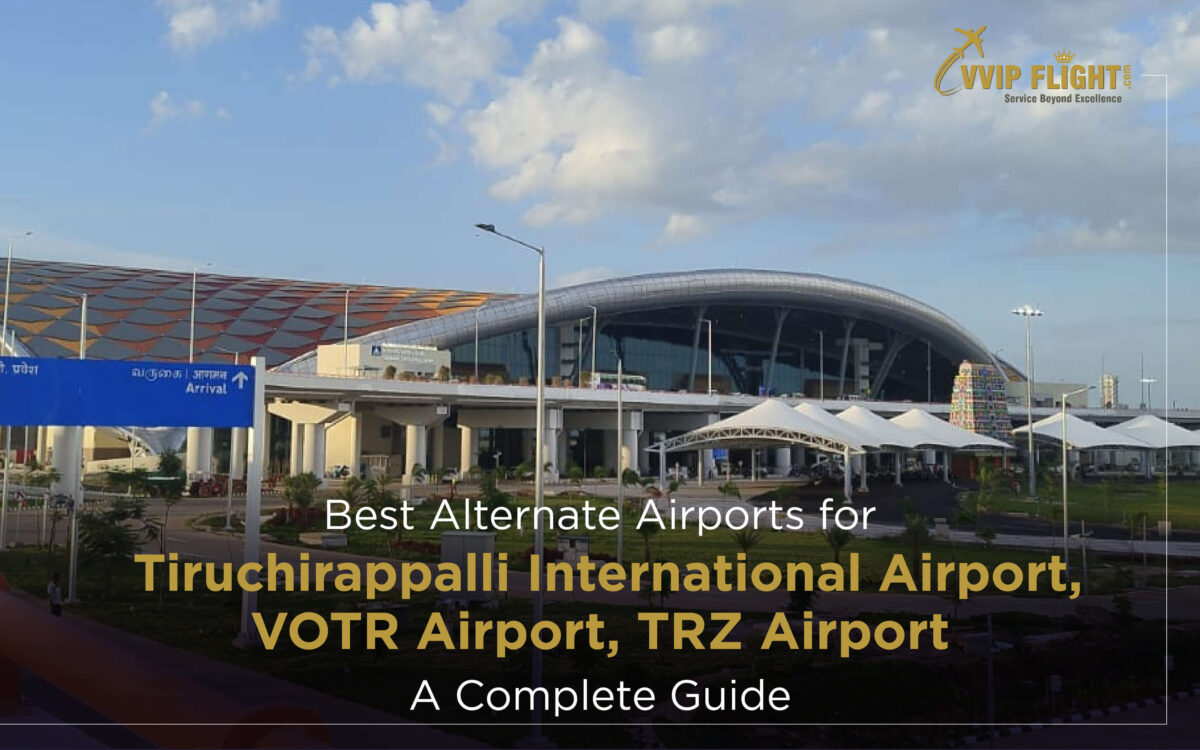
Best Alternate Airports for Tiruchirappalli International Airport, VOTR Airport, TRZ Airport – A Complete Guide

  1. Airport Name: COIMBATORE AIRPORT
  • ICAO Code: VOCB
  • IATA Code: CJB
  • City: COIMBATORE
  • Distance in Nautical Miles: 100 NM
  • Operating hours of VOCB Airport: H24
  • Restrictions if any: NIL AS OF DATE
  • AOE (Airport of Entry): YES (International Airport)
  • Customs/ Immigration at VOCB Airport: AVAILABLE
  • Type of Airport: CIVIL
  • RFFS at VOCB Airport: CAT VIII
  • Fuel Availability: JET A1
  • Ground Handler at Coimbatore Airport: VVIP FLIGHT PRIVATE LIMITED (ops@vvipflight.com)

2. Airport Name: KANNUR INTERNATIONAL AIRPORT

  • ICAO Code: VOKN
  • IATA Code: CNN
  • City: KANNUR
  • Distance in Nautical Miles: 199 NM
  • Operating hours of VOKN Airport: H24
  • Restrictions if any: NIL AS OF DATE
  • AOE (Airport of Entry) –YES (International Airport)
  • Customs/ Immigration at VOKN Airport: Available
  • Type of Airport: CIVIL
  • RFFS at VOKN Airport: CAT IX
  • Fuel availability: JET A1
  • Ground Handler at Kannur International Airport: VVIP FLIGHT PRIVATE LIMITED (ops@vvipflight.com)

3. Airport Name: CALICUT INTERNATIONAL AIRPORT

  • ICAO Code: VOCL
  • IATA Code: CCJ
  • City: CALICUT
  • Distance in Nautical Miles: 165 NM
  • Operating hours of VOCL Airport: H24
  • Restrictions if any: 0900 UTC – 1200 UTC (EVRY TUE & THU)
  • AOE (Airport of Entry): YES
  • Customs/ Immigration at VOCL Airport: AVAILABLE
  • Type of Airport: CIVIL
  • RFFS at VOCL Airport: CAT VII
  • Fuel Availability: JET A1
  • Ground Handler at Calicut Airport: VVIP FLIGHT PRIVATE LIMITED (ops@vvipflight.com)

4. Airport Name: COCHIN INTERNATIONAL AIRPORT

  • ICAO Code: VOCI
  • IATA Code: COK
  • City: COCHIN
  • Distance in Nautical Miles: 141 NM
  • Operating hours of VOCI Airport: H24
  • Restrictions if any: 0830 UTC – 1200 UTC (EVRY 2nd TUE)
  • AOE (Airport of Entry) –YES (International Airport)
  • Customs/ Immigration at VOCI Airport: Available
  • Type of Airport: CIVIL
  • RFFS of VOCI Airport: CAT IX
  • Fuel Availability: JET A1
  • Ground Handler at Cochin International Airport: VVIP FLIGHT PRIVATE LIMITED (ops@vvipflight.com)

5. Airport Name: MADURAI INTERNATIONAL AIRPORT

  • ICAO Code: VOMD
  • IATA Code: IXM
  • City: MADURAI
  • Distance in Nautical Miles: 67 NM
  • Operating hours of VOMD Airport: H24
  • Restrictions if any: NIL AS OF DATE
  • AOE (Airport of Entry): YES (International Airport)
  • Customs/ Immigration at VOMD Airport: AVAILABLE
  • Type of Airport: CIVIL
  • RFFS at VOMD Airport: CAT VI
  • Fuel Availability: JET A1
  • Ground Handler at Madurai International Airport: VVIP FLIGHT PRIVATE LIMITED (ops@vvipflight.com)


Quick Enquiry

Quick Enquiry
Close