
A Head of State visit to India is not a flight; it’s a sovereign event conducted at altitude and on the ground. From the moment the aircraft enters Indian airspace to the moment it departs, every element of the operation falls under a precise framework of diplomatic protocol, security coordination, and inter-ministerial approvals.
VVIP Flight Pvt Ltd has managed Head of State, presidential, and senior diplomatic mission handling at Indira Gandhi International Airport (DEL, VIDP) and across India’s major airports.
This guide explains the key elements of that protocol framework for embassy mission planners, diplomatic advance teams, and flight operations coordinators preparing an official visit to India.
Step 1: AOR Number and Diplomatic Clearance — Understanding the Difference
The first and most important distinction any mission planner must understand is the difference between a Diplomatic Flight Clearance and an AOR number. Confusing the two is the most common source of permit failure for foreign diplomatic missions flying into India.
Diplomatic Flight Clearance is required for all foreign state aircraft landing at civil international airports. This clearance is issued by the Ministry of External Affairs (MEA) and validated by the DGCA. The embassy submits a Note Verbale to the MEA, which grants Diplomatic clearance for the DGCA to issue the flight clearance number. Standard lead time is 3 to 7 working days, or permits can be issued on short notice depending on the urgency of the mission.
AOR (Air Operation Routine) is an entirely separate clearance issued by the Ministry of Defence (MoD)in coordination with Air HQ or Naval HQ, depending on the airport. It is required when the mission involves landing at a Defence Airfield or Military aircraft or Aircraft with a Military Call sign or parking at a Military apron. The lead time for an AOR is 15 to 20 working days, or permits can be issued on short notice, depending on the urgency of the mission. The vetting is significantly more rigorous, and it cannot be waived even for a Head of State visit. An MEA diplomatic clearance does not substitute for an AOR at a military airport, as it’s an additional clearance issued by MOD and passed on to MEA based on a request submitted by the Embassy.
Step 2: Aircraft Parking at Delhi Airport
Aircraft carrying Heads of State at Delhi Airport are parked in the Palam Air Force technical area, located separately from Terminal 3 and the commercial aviation infrastructure of VIDP. Parking allocation within the technical area is coordinated by Base Ops in coordination with Delhi ATC, based on apron traffic at the time of arrival.
All coordination for parking in the technical area is handled through diplomatic channels and must be confirmed well in advance of the mission date.
Step 3: Red Carpet and the State Lounge (Ceremonial Lounge)
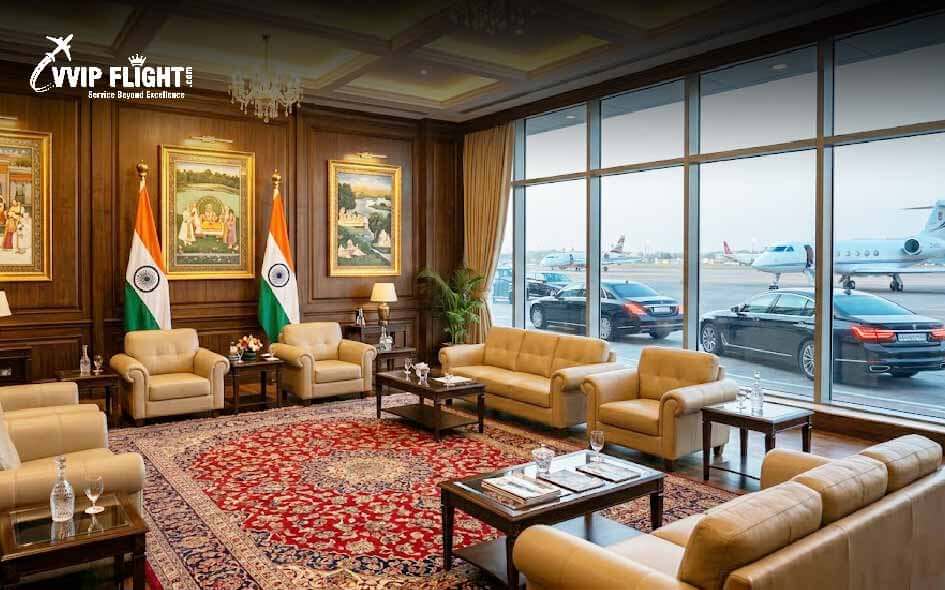
For Heads of State, the commercial terminal is not used at any stage. Delhi Airport’s State Lounge, also known as the Ceremonial Lounge, is located at the Palam Air Force Station technical area, entirely separate from public-facing terminals.
This facility provides a controlled, private environment for a formal Red Carpet reception away from any public presence. Access to the State Lounge is controlled strictly by the MEA Protocol Division, and all arrangements must be coordinated through the embassy’s diplomatic channels with the MEA.
For visiting Ministers, Ambassadors, and delegation members of lower protocol rank, the General Aviation Terminal (GAT) at Delhi Airport or the Ceremonial lounge situated at Terminal-3 of Delhi Airport provides a private, professionally managed environment separate from the commercial terminals, though distinct from the IAF Technical Airport area ( Palam Airport) Ceremonial Lounge.
Step 4: The Arrival Convoy
On both arrival and departure, all Head of State flights at Delhi Airport are escorted by a Follow Me vehicle as part of standard protocol. The convoy moves between the aircraft and the technical area under coordinated security procedures.
Tarmac access for vehicles is strictly controlled and varies by the diplomatic rank of the arriving principal.
Heads of State, Heads of Government, Presidents, and Vice Presidents are categorised at the highest protocol level and receive direct tarmac vehicle access as standard.
All requests for embassy staff, advance team personnel, security personnel, and vehicles within the technical area must be submitted through the embassy to the Ministry of External Affairs by Note Verbale. The MEA then coordinates approval with Air Headquarters (Air HQ). Only the specific personnel and vehicles named in the approved submission are permitted access. No variations are permitted on the day of the mission until approved by MEA and AIR HQ.
Step 5: Arms, Weapons, and Security Personnel Clearance
Diplomatic missions that include armed security personnel require specific prior clearances that must be obtained before the aircraft arrives in India.
All arms and ammunition carried onboard must be declared in full to the Ministry of External Affairs by Note Verbale. The clearance process involves the Ministry of Home Affairs (MHA) approving the carriage of firearms, and the Bureau of Civil Aviation Security (BCAS) validating that clearance. Customs authorities and the relevant security agencies inspect all arms on both arrival and departure, in accordance with the approved clearances.
Undeclared weapons, regardless of the diplomatic status of the person carrying them, will be subject to immediate action by Indian security authorities. This applies equally to all foreign missions.
Step 6: Aircraft Security on the Ground
India deploys local security forces to protect all aircraft parked in the technical area in accordance with established security protocols. This is standard practice at Delhi Airport for all Head of State visits.
Some countries choose to deploy their own security personnel to guard the aircraft in addition to the local security forces. This is operationally possible but requires formal approval through diplomatic channels. The respective embassy must submit the request to the MEA, which coordinates approval with Air Headquarters. Only the security personnel and vehicles specifically listed in the approved authorisation may access the aircraft in the technical area.
Step 7: Catering Protocol for VVIP Flights
For flights where a Head of State is on board, the Indian Government VVIP Protocol Regulations require that the caterer provide samples of all food items uplifted on the VVIP flight. These samples are presented to the relevant security agencies, Delhi Police, and the Airport Health Officer (APHO) as part of standard protocol. Mission planners and caterers must factor this requirement into the catering coordination timeline.
Step 8: Baggage Screening
All baggage is subject to mandatory security screening prior to departure from Delhi Airport as per local security procedures. If the embassy requires an exemption from security screening for any or all baggage, a formal exemption request must be submitted to the MEA and the necessary approvals obtained before the aircraft arrives in India. Exemptions cannot be arranged on the day and cannot be assumed based on diplomatic status alone.
Step 9: Crew and Passenger Visa Requirements
Crew arriving in India must carry a valid Business Visa issued by the Indian Embassy or Consulate, or an e-Business Visa obtained through the Government of India’s official e-Visa portal.
Passengers must carry a valid visa issued by the Indian Embassy or Consulate, or an e-Visa.
Visa requirements do not apply to holders of diplomatic passports where a bilateral agreement between the countries provides for visa exemption. Embassies should verify the applicable bilateral arrangements for their specific nationality before finalising crew and passenger documentation.
For missions operating on short notice, the local embassy can request a visa on arrival through a formal request to the MEA.
Step 10: Fuel Tax Exemptions
Diplomatic flights operating into India are eligible for Excise Duty Exemption on Aviation Turbine Fuel (ATF). The embassy must formally request this exemption, and the relevant paperwork must be managed through the appropriate channels before the aircraft arrives. VVIP Flight coordinates this exemption process on behalf of diplomatic missions.
India’s G20 Presidency: A Reference Point for Large-Scale Diplomatic Aviation
India’s G20 Presidency, with the Leaders’ Summit held in New Delhi, provided the most significant recent example of large-scale diplomatic aviation coordination at Indian airports. Aircraft movements for Heads of State, delegations, and diplomatic missions from all G20 member nations and guest countries were managed simultaneously across Delhi’s technical area.
The operation required concurrent coordination of AOR and diplomatic clearances for multiple aircraft, parallel parking allocations in the technical area, overlapping convoy and reception protocols for multiple Heads of State, coordinated arms clearances for numerous security details from different countries, and sequential catering and baggage protocol compliance for each departing VVIP flight.
The G20 summit demonstrated that when every element of the diplomatic aviation protocol is managed correctly and in advance, even the most complex simultaneous multi-principal operation can be executed without incident. The framework described in this guide is the same framework that governed each of those missions.
Checklist for Diplomatic Mission Planners at Delhi Airport
- Note Verbale: Drafted and submitted to MEA with sufficient lead time for all inter-ministerial approvals.
- Airport type: Confirmed as civil (VIDP) or defence (requiring AOR from MoD). Lead time established accordingly.
- AOR number: Applied for if applicable, with 15 to 20 working days lead time factored in.
- Diplomatic clearance: MEA clearance, AOR number, and DGCA flight clearance number confirmed.
- Tarmac access: Embassy submission to MEA naming all specific personnel and vehicles requiring technical area access.
- Arms clearance: MHA approval and BCAS validation confirmed for all weapons carried by security personnel.
- Baggage exemption: Exemption request submitted to MEA if required, and approved before aircraft arrival.
- Ground handling: Local handler confirmed for Ground Handling, Slots coordination, fuel, catering, baggage, and ramp coordination. Airport authorities do not automatically provide private aviation handling. A dedicated local handler must be appointed. VVIP Flight (ops@vvipflight.com) will be happy to assist.
- Fuel exemption: Tax-exempt ATF arranged and paperwork coordinated.
- Catering protocol: Food sample protocol confirmed with the caterer for VVIP flights.
- Crew visas: Valid Business Visa or e-Business Visa confirmed for all crew. Diplomatic passport exemptions verified where applicable.
- Aircraft security: Local security confirmed. Embassy security deployment request submitted and approved through MEA and Air HQ if applicable.
- Parking exemption: Parking exemption request submitted through MEA and Air HQ if applicable.
VVIP Flight: Head of State and Diplomatic Mission Handling
VVIP Flight Pvt Ltd provides dedicated Head of State and diplomatic mission handling at Indira Gandhi International Airport (DEL, VIDP) and across all major Indian airports. Services include full permit coordination, Ground Handling, Slots coordination, Parking coordination, Fuel coordination, Catering services, crew transportation, crew visa assistance, arms clearance facilitation, fuel exemption processing, catering protocol coordination, tarmac and convoy logistics, crew support, and aircraft security coordination on behalf of visiting embassies and diplomatic missions.
Please feel free to contact us for any assistance at: ops@vvipflight.com
Disclaimer: Kindly note that the information provided in the above article is subject to change without prior notice. We recommend contacting our operations team for the latest regulations, updates, and accurate information before planning your trip.
Frequently Asked Questions (FAQs)
- What is an AOR clearance, and when is it required?
An Air Operations Routine (AOR) clearance is typically required when a diplomatic or state aircraft operates into a military or defence-controlled airport in India.
- Where are the Head of State aircraft parked at Delhi Airport?
Head of State aircraft are generally parked within the Palam Air Force technical area, subject to operational and security requirements.
- Can embassy officials receive dignitaries directly at the aircraft?
Yes, but access must be approved in advance through diplomatic channels and coordinated with the relevant authorities.
- Can foreign security personnel carry firearms during a state visit to India?
Protective security arrangements may be permitted subject to advance approvals obtained through the appropriate diplomatic process.
- Can a foreign security team guard the aircraft while it is parked in India?
Certain countries may request authorization for their own security personnel to oversee aircraft protection, subject to government approval.
- How long does it take to obtain diplomatic flight clearance for a Head of State or diplomatic mission flight to India?
Diplomatic flight clearance is generally processed within 3 to 7 working days after the embassy submits a Note Verbale to the Ministry of External Affairs. However, urgent requests for Heads of State, government delegations, humanitarian missions, and other special flights may be processed on shorter notice, subject to approval by the relevant Indian authorities.
